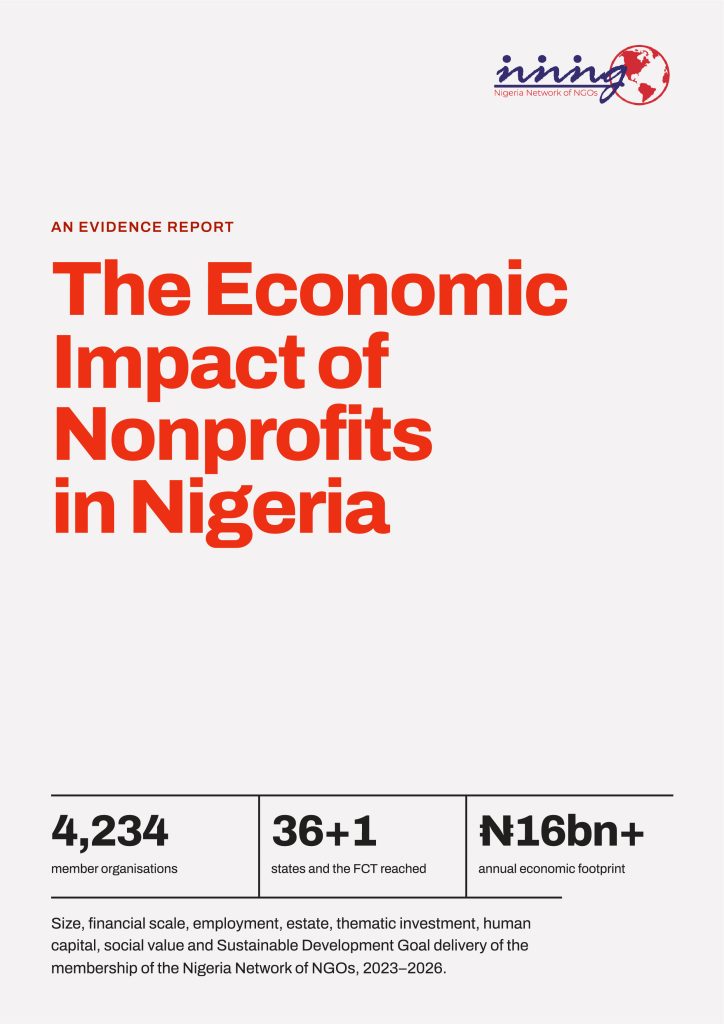
The Economic Impact of Nonprofits in Nigeria

An Evidence Report  2026

Nigeria’s nonprofit sector is a substantial, nationally distributed economic actor. This evidence report quantifies the contribution of the Nigeria Network of NGOs’ 4,234 member organisations — present in every one of the country’s 36 states and the Federal Capital Territory.


Drawing on the membership database, an inventory of civil society events (2023–mid-2026), a review of university programme pages, and documented member impact features, the report examines financial scale, employment, the nonprofit estate, thematic investment, the convening economy, human capital, social value, and Sustainable Development Goal delivery.

Conservative estimates place the membership’s total annual economic footprint at ₦16.4–17.5 billion (direct, indirect and induced effects), with a plausible range of ₦14–22.5 billion. The organisations support 3,100–6,900 full-time-equivalent paid posts alongside substantial volunteer effort, generate significant local demand for hospitality, transport, professional services and telecommunications, and deliver measurable results across 12 of the 17 Sustainable Development Goals.

These figures are deliberately cautious and represent a lower bound on the sector as a whole. They demonstrate that the economic weight of Nigerian nonprofits is both real and under-recognised — and that measuring it more fully is the first step toward resourcing civil society in proportion to the value it creates.

Download the full report to explore the data, methodology, limitations and findings in detail.
Fill the form below to download The Economic Impact of Nonprofits in Nigeria


STAYING NONPARTISAN

A Guide for Nigerian Civil Society Organisations Registered under Part F of CAMA on Non-Partisanship, Political Campaigning and Advocacy during the 2027 General Elections

Kindly fill the below form to download the Stay Partisan Document


NGO Compliance Checklist

This checklist is designed to help nonprofit organizations monitor their statutory, regulatory, financial, governance, and operational obligations throughout the year. It should be reviewed regularly and adapted to your organization’s structure and activities.

Kindly fill the form below to download NGO Compliance Checklist


COMPLIANCE GUIDE on CAC Public Notice: Particulars on Company Business Letters

CAC Public Notice: Particulars on Company Business Letters

Under the Companies and Allied Matters Act (CAMA) 2020

Enforcement commences 1st August 2026

A Practical Resource for Nonprofit Organisations in Nigeria

Nigeria Network of NGOs (NNNGO)

Fill this Form to download the Compliance Guide on CAC Public Notice: Particulars on Company Business Letters


Civil Society at Risk

Civil Society at Risk

A Sector-Wide Assessment of Organisational Capacity and Risk

An analysis of 391 Nigerian civil society organisations through two complementary lenses: the nine NOPSAT capacity domains and the seven standard risk categories used across the international development sector — Security, Safety, Operational, Fiduciary, Reputational, Legal/Compliance and Information

Fill this Form to download the Civil Society at Risk


Digital Risk Assessment Report May 2026

This Digital Risk Assessment analyses self-reported responses from 286 Nigerian civil society organisations (CSOs) to a 95-question audit instrument covering identity and access management, network and data protection, third-party risk, vulnerability management, cloud and mobile security, incident response, physical security, anti-malware, awareness training, and governance and compliance. Responses were normalised, cross-tabulated across 17 control domains aligned with ISO/IEC 27001 Annex A and the NIST Cybersecurity Framework, and correlated against organisational coverage, geographic distribution, and inter-domain dependencies

Fill this Form to download the Digital Risk Assessment Report May 2026


Digital Resilience Toolkit

This toolkit turns the findings of the NNNGO Digital Risk Assessment into action. The assessment surveyed 286 civil society organisations across all 36 States and the FCT and found that, while the median organisation implements about three-quarters of expected controls, roughly two-in-five are “Basic” or “Critical” – lacking the protections needed to safely hold beneficiary data, meet donor obligations, or recover from a serious incident. This toolkit gives
every CSO, whatever its size or budget, a clear path to digital resilience.
 

Fill this Form to download the Digital Resilience Toolkit for Civil Society Organisation


Compliance Plan and Operational Summary-Nigeria Tax Act 2025

Key Deadlines Snapshot

14th of Every Month: VAT Remittance for Imported/Foreign Services (Reverse Charge). NTA Sec 155.

21st of Every Month: Standard VAT Return, WHT Remittance, PAYE Remittance. NTAA Section 107.

30th June (Typical): Annual Corporate Income Tax Return (incorporating Nil Return for exemption). NTAA Sec 11

Fill this below form to Download the Compliance Plan and Operational Summary-Nigeria Tax Act 2025


Civil Society RegulatoryFrameworksin Nigeria

The purpose of this research is to better understand the current landscape of civil society regulations in Nigeria, contribute to and bring knowledge to national conversations on civil society regulations and examine best practices and tools for self-regulation.

Fill this form to download te document above


The Nigeria Network of NGOs (NNNGO) is the first generic membership body for civil society organisations in Nigeria that facilitates effective advocacy on issues of poverty and other developmental issues. Established in 1992, NNNGO represents over 3495 

Do you have questions? Call or visit us.

+2349069460107

Plot 3 Sobanjo avenue, Idi-ishin Jericho Ibadan, Oyo, Nigeria.

15 Ramat Crescent, Ogudu GRA, Lagos, Nlgeria

nnngo@nnngo.org 

Newsletter

Get latest news & update

Connect With Us

© – Nigeria Network of NGO (NNNGO). All rights reserved.

Follow us on social media