2022 ANNUAL REPORT – ENABLING THE NIGERIAN CIVIC SPACE, ONE ORGANISATION AT A TIME.

2022 Annual Report

The nonprofit sector remains actively engaged in charitable doings across Nigeria, playing a pivotal role in the  development of society especially in lower middle-income Nigeria. The Nigeria Network of NGOs in 2022
continued in its commitment to ensuring the growth of civic space through its many activities, projects and engagements.

In 2022, we communicated our activities with our members and other audience  groups using emails campaigns, direct emails, phone calls, text messaging, a closed WhatsApp group strictly set up for paid members, and via various social media platforms such as Facebook, Twitter, Instagram, and LinkedIn. We used physical correspondence by sending official letters to offices of regulators and public office holders to share our publications and request for meetings to discuss the progress of the Nigerian civic space as well as the
country at large.

Kindly fill this form to download the 2022 Annual Report – Enabling The Nigerian Civic Space, One Organisation at The a Time


2023 ANNUAL REPORT NONPROFIT SURVIVAL IN AN ECONOMIC DOWNTURN

OUR NUMBER
Our membership increased from 3,623 in December 2022 to 3,912 in December 2023. We successfully implemented 10 projects and organized 9 virtual trainings on nonprofit management courses. We engaged our audience across our social media platforms using multimedia messaging in a total of 926 posts with: 451,713 impressions and 267,556 engagements on Facebook; 211,990 impressions and 114,308 engagements on Twitter; 187,865 impressions and 94,382 engagements on Instagram.

OUR MEMBER
Trainings and workshops hosted by NNNGO in 2023 prioritized gender equality, capturing participation data and ensuring equal opportunities for both genders, different age groups (youths and adults) and ensuring
representative attendance of persons with disabilities demonstrating a commitment to diversity and inclusion. Meeting facilities and rooms were accessible to persons with disabilities, including making provisions for the participation of their support staff especially for project related workshops in line with global best practices.

NNNGO majorly communicated with its  members via emails campaigns, direct emails, phone calls, text messaging, a closed WhatsApp group strictly set up for paid members, and via various social media platforms such as Facebook, Twitter, Instagram and LinkedIn.

Kindly fill this form to download the 2023 Annual Report Nonprofit Survival In an Economic Downturn


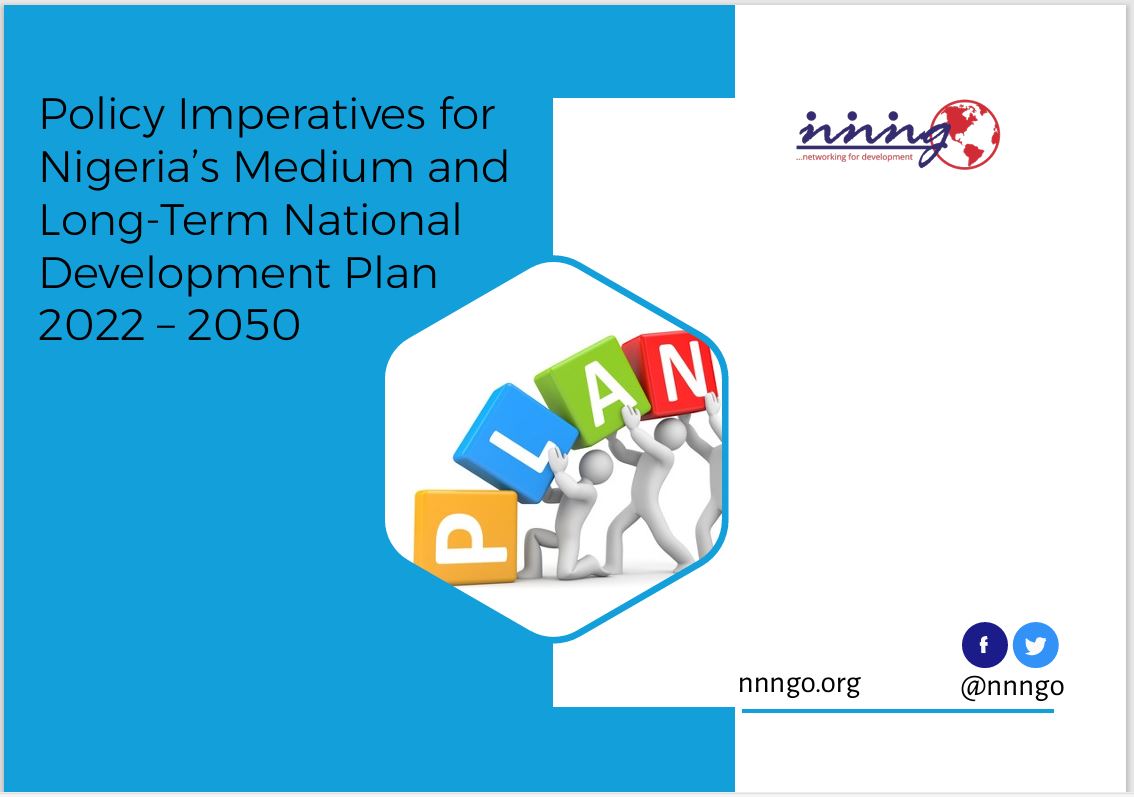
Policy Imperatives for Nigeria’s Medium and Long-Term National Development Plan 2022 – 2050

With its diverse and growing economy, Nigeria, which is often referred to as the giant of Africa, continues to be ranked amongst countries with the lowest economic competitiveness in view of her weak systems – political, legal, regulatory frameworks, transport, education, health, and infrastructure – coupled with growing ethnic intolerance, religious crises, insurgency, banditry, criminalities, and an overall corrupt ecosystem, thus creating a complex landscape for Nigeria’s decades of underdevelopment.

In recent years, Nigeria has seen governments taking decisions aimed at achieving economic recovery and growth through policies and incentives to ease doing business, investments in formal and informal sectors, export and import activities, boosting of agricultural programmes, and job creation – all laying a foundation for sustainable growth. The government’s long-term economic plan (Vision 20.20.20) has shaped the economy through a period of abundance, with the Economic Recovery Growth Plan (ERGP) protecting it during the nation’s period of uncertainty while providing the foundations for recovery from the 2017/2018 economic recession.

Kindly fill this form to download the Policy Imperatives for Nigeria’s Medium and Long-Term National Development Plan 2022 – 2050


post

[fluentform id=”3″]

Nigeria Network of NGOs Trains Nonprofits on the Fundamentals of Grant Proposal Writing.

Nigeria Network of NGOs Trains Nonprofits on the Fundamentals of Grant Proposal Writing.

Lagos- NIGERIA

By Oyindamola Aramide

The training focused on grant writing as the process of creating a proposal to request funding from a grant organization, government agency, foundation, or other funding source. The facilitator, Ms. Tsema Ede, Program Director, JCDF, provided an overview of the different types of grants available, including government grants, private foundation grants, and corporate grants. 

Ms. Ede explained that the goal of grant writing is to convince the funder that the proposed project or program is worthy of their support. This involves presenting a compelling case, outlining the project objectives, methods, and expected outcomes, as well as demonstrating that the funds will be used responsibly. 

The different types of grants discussed include government grants, which are typically competitive and address public needs and priorities, and private foundation grants, which are provided by independent entities with their own endowments and specific missions. Corporate grants were also mentioned, which are part of a company’s corporate social responsibility efforts. 

Ms. Ede then outlined the key components of a grant proposal, including an executive summary, a statement of need or problem statement, goals and objectives, methods and approach, an evaluation plan, a budget, and a sustainability plan. She emphasized the importance of keeping the proposal concise and focused on the most critical elements. 

Using a sample proposal for a gender-based violence intervention organization, Ms. Ede demonstrated how to structure the different sections of the proposal, such as introducing the issue, identifying specific challenges, emphasizing the impact on the community, and outlining the proposed solutions and activities. 

She stressed the importance of clearly articulating the problem, the goals and objectives, and the methods for addressing the problem. The evaluation plan is also crucial, as it allows the funder to understand how the organization will measure the success of the project. 

She advised that the budget should be comprehensive, covering all the necessary expenses, such as workshop materials, travel, and accommodation. She emphasized the need to demonstrate the sustainability of the proposed intervention, as funders are often concerned about the long-term viability of the project. 

Throughout the discussion, Ms. Ede Sheema encouraged the participants to think about their own work and the specific challenges they face in their ground rights efforts. She invited them to share their experiences and questions, which she addressed as the conversation progressed. 

She emphasized the importance of a well-crafted proposal that clearly articulates the problem, the proposed solution, and the expected outcomes. She stressed the importance of ensuring that budgets are reasonable and not overly ambitious, as donors may be hesitant to work with organizations that appear dishonest or wasteful. 

She said, “When it comes to grant writing, it’s crucial to know what you want to do and research the available funding opportunities. Meeting the eligibility criteria is essential, as is developing a compelling proposal that showcases the importance of the work and the need for funding. Storytelling is a valuable tool in this process.” 

The budget and financial planning are also critical components. Applicants should present a clear and realistic budget and follow up with the funder to address any questions or concerns. Attention to detail and adherence to the funder’s guidelines are key to a successful application. 

It’s important to research the funder’s strategy, priorities, and previously funded projects to ensure that the proposal aligns with their interests. Clarity, conciseness, and consistent terminology are essential in the proposal writing process, as they make the application more accessible and enjoyable for the reader. 

Methodology and approach should be clearly outlined, with a focus on realistic and achievable goals. Potential challenges and mitigation strategies should also be addressed, demonstrating the applicant’s understanding of the project’s risks and their ability to manage them. 

Following the funder’s application guidelines is crucial, as deviating from them can create unnecessary stress and reduce the chances of success. Proofreading and editing the proposal to ensure accuracy and professionalism are also important steps in the grant writing process. 

Common challenges in grant writing include failing to understand the guidelines, lack of clarity in objectives, weak problem statements, and inadequate research on the funder’s priorities and previously funded projects. Addressing these issues can significantly improve the chances of a successful application. 

Applicants should also ensure that their background and experience are relevant to the funder’s interests and the proposed project. Brevity, precision, and staying within word limits are crucial in the proposal writing process. 

Ms. Ede also noted that sustainability beyond the grant period is a key consideration. Applicants should outline how they intend to sustain the projects, and include appendices like detailed project timelines, work plans, and resumes of key personnel. Letters of support from community leaders and organizations can also strengthen the application. 

Finally, it’s important to remember that grant writing is a competitive process, and funders often have specific priorities and preferences. By understanding these factors and tailoring the proposal accordingly, applicants can increase their chances of securing the necessary funding for their projects.

initial response to carnegie and Mr. T page on fake civil society report

On behalf of the Board, members and staff of the Nigeria Network of NGOs (NNNGO), I write to express our grave concerns with the report written by Mr. Matthew T Page, a non-resident scholar at the Carnegie Endowment for International Peace published on Carnegie’s website at https://carnegieendowment.org/2021/07/28/fake-civil-society-rise-of-pro-government-ngos-in-nigeria-pub-85041?utm_source=carnegieemail&utm_medium=email&utm_campaign=announcement&mkt_tok=MDk1LVBQVi04MTMAAAFjGqpq0Ro0tfbednVFFmt1b54oDL6UPwNel0qZwcqchLv_JunVFVLstV_byJK_tsUex4_H8uLDrEhbXpcksZBX1Zdhz7TuBBQDDnU0nBci_M on 28 July, 2021.

While we welcome a review of the civil society sector in Nigeria, we are worried that a research report such as the one published by Carnegie damages the reputation of civil societyorganisations in the South especially when it is not grounded in rigorous methodology and evidence.

NNNGO is the first generic membership organisation for nonprofits in Nigeria dedicated to improving the operational environment for nonprofits. NNNGO brings together more than 3,300 nonprofits from around the country focused on education, health, environment, gender, agriculture, social protection, youth, poverty, good governance, and other areas of progressing national development. Since 1992, NNNGO has worked to advance the common interests of the sector, providing programs that advance national development, civil society legitimacy, transparency, and accountability.

.Our initial response will be limited to the “key takeaways” section and Note 3 titled Based on analysis of a detailed, author-compiled data set of more than 360 pro-government NGOs. It is accessible at: https://tinyurl.com/55bem3n8 of the report at this time.

.

The Nigeria Network of NGOs (NNNGO) is the first generic membership body for civil society organisations in Nigeria that facilitates effective advocacy on issues of poverty and other developmental issues. Established in 1992, NNNGO represents over 3495 organisations ranging from small groups working

Do you have questions? Call or visit us.

+2349069460107

Plot 3 Sobanjo avenue, Idi-ishin Jericho Ibadan, Oyo, Nigeria.

15 Ramat Crescent, Ogudu GRA, Lagos, Nlgeria

nnngo@nnngo.org 

Newsletter

Get latest news & update

Connect With Us

© 2025 – Nigeria Network of NGO (NNNGO). All rights reserved.

Follow us on social media