Nonprofit Compliance Plan & Operational Summary: Nigeria Tax Act 2025.

Nonprofit Compliance Plan & Operational Summary: Nigeria Tax Act 2025.

Key Deadlines Snapshot

14th of Every Month: VAT Remittance for Imported/Foreign Services (Reverse Charge). NTA Sec 155.

21st of Every Month: Standard VAT Return, WHT Remittance, PAYE Remittance. NTAA Section 107.

30th June (Typical): Annual Corporate Income Tax Return (incorporating Nil Return for exemption). NTAA Sec 11.


Fill this form to download the Nonprofit Compliance Plan & Operational Summary: Nigeria Tax Act 2025.


2025 Budget Speech and the SDGs

On December 19, 2025, President Bola Ahmed Tinubu presented Nigeria’s 2026 Appropriation Bill, titled “Budget of Consolidation, Renewed Resilience and Shared Prosperity,” to a joint session of the National Assembly in Abuja.

Valued at approximately ₦58.18 trillion, the budget builds on two-and-a-half years of economic reforms aimed at stabilizing the macroeconomy amid challenges like inflation and residual effect of the subsidy removal. Key priorities of the 2025 budget include national security (₦5.41 trillion), infrastructure (₦3.56 trillion), education (₦3.52 trillion), health (₦2.48 trillion), and agriculture for food security and climate resilience.


Kindly fillthis form to downalod the 2025 Budget Speech and the SDGs


2025 in Review: Strengthening Civil Society Across Nigeria and Beyond

2025 in Review: Strengthening Civil Society Across Nigeria and Beyond

‎‎In 2025, the Nigeria Network of NGOs advanced its commitment to building a strong, inclusive, and enabling environment for civil society organisations. Through strategic programmes, capacity development initiatives, research, and digital engagement, NNNGO continued to support nonprofits to thrive, collaborate, and deliver meaningful impact.

Advancing Strategic Priorities

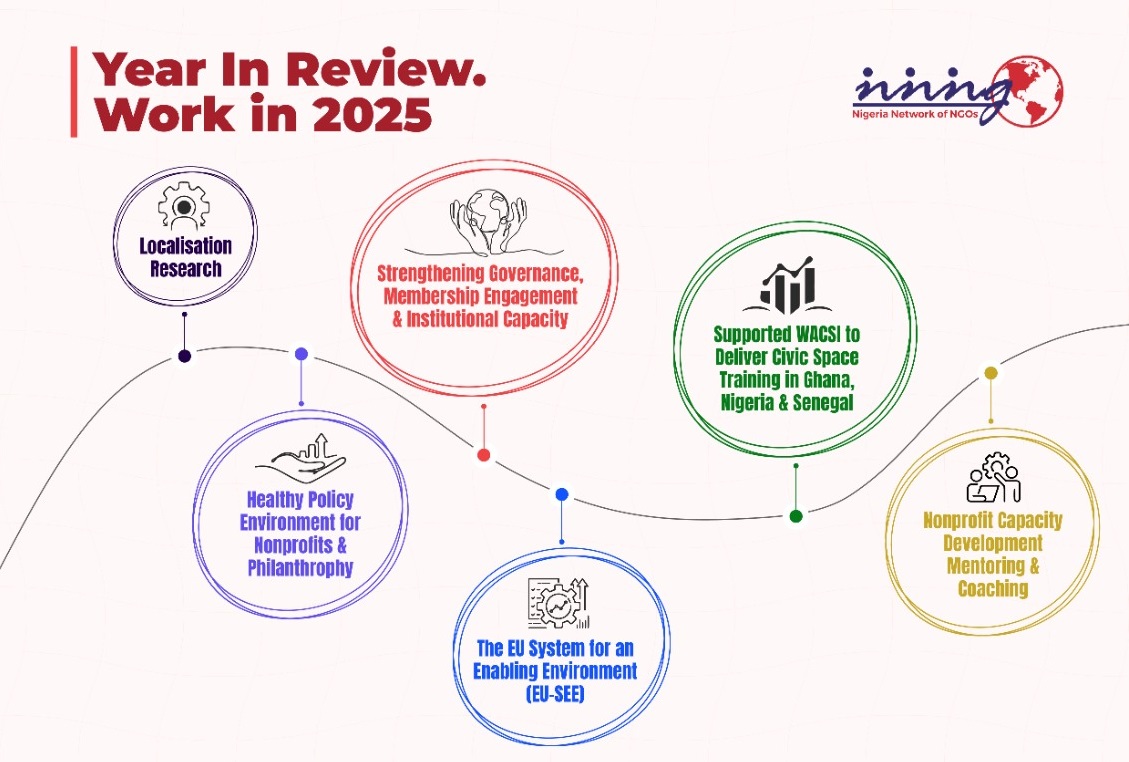
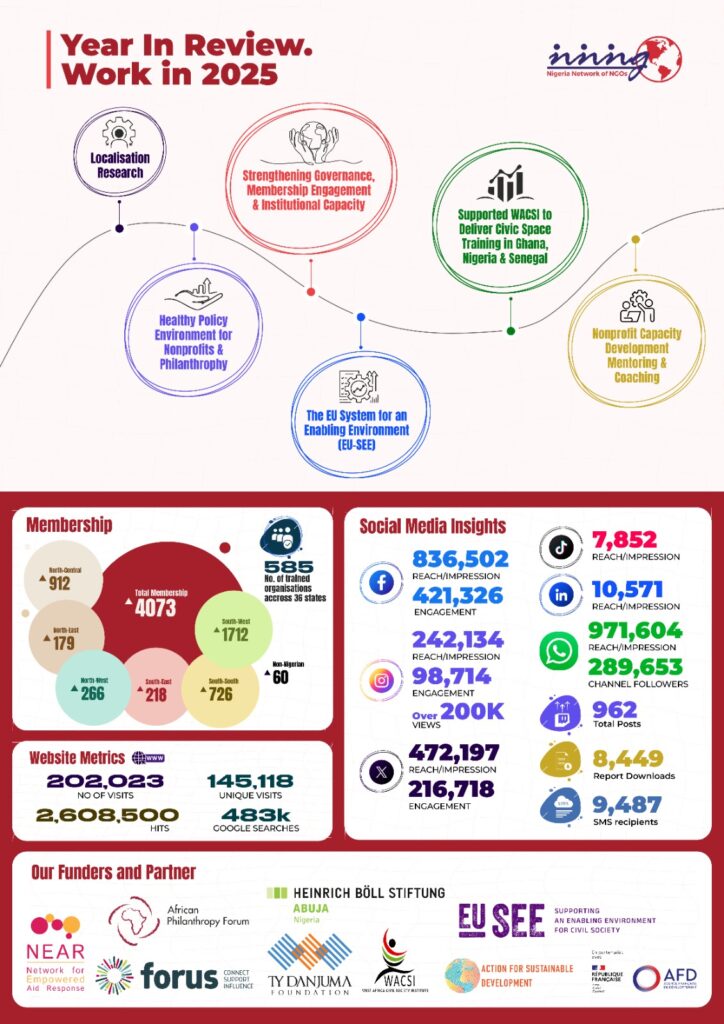
‎Throughout the year, NNNGO implemented key interventions aimed at strengthening institutional capacity and improving the operating environment for civil society. These efforts included localisation research to generate context-driven solutions, strengthening governance systems and membership engagement, and promoting a healthy policy environment for nonprofits and philanthropy.

‎The Network also played an active role in the EU System for an Enabling Environment (EU-SEE), contributing to initiatives that support civic space and civil society sustainability. Across West Africa, NNNGO supported the West Africa Civil Society Institute (WACSI) to deliver civic space training in Ghana, Nigeria, and Senegal, reinforcing regional collaboration and learning. Nonprofit capacity development initiatives through mentoring and coaching remained central to strengthening organisational effectiveness.

Our Projects Include:

‎👉Localisation Research

‎ Targeted at creating solutions to the realities, challenges, opportunities, and readiness of local civil society actors within Nigeria’s humanitarian and development ecosystem.

‎👉Strengthening Governance, Membership Engagement & Institutional Capacity

‎ Targeted at deepening member engagement, improving board governance, and expanding internal human resource and MEAL capacities.

‎👉Civic Space Protection & Accountability

‎Targeted at strengthening civic freedoms, improve nonprofit regulatory understanding, and enhance the accountability of state institutions toward Nigeria’s human rights commitments with key interventions and achievements including the development of a Policing Protest Toolkit.

‎👉Civil Society Mapping and Capacity Assessment in Nigeria

‎Targeted at mapping the CSO landscape to identify and categorise CSOs by formation geographic spread, thematic focus, and funding sources and assessing capacity needs to evaluate institutional, operational, programmatic, regulatory, technological, resource mobilisation, strategic planning, and digital protection capacities, while documenting the challenges they face in fulfilling their mission.

‎👉Nigerian Nonprofit Capacity Building Trainings

‎Targeted at enhancing NGO governance, compliance, project management, financial accountability, and organisational sustainability, ensuring that beneficiary organisations are better equipped to deliver impactful and transparent services to the communities they serve.

‎👉The EU System for an Enabling Environment (EU-SEE)

‎Targeted at strengthening national monitoring, analysis, and advocacy relating to the enabling environment for civil society.

‎👉The Civic Space Resource Hub

‎Targeted at developing the capacities of civil society organisations in Nigeria, Ghana, and Senegal.

Growing and Engaged Membership

‎NNNGO’s membership base continued to expand in 2025, reaching a total of 4,073 member organisations. These members span across Nigeria’s six geopolitical zones, with strong representation in the South-West, South-South, and North-Central regions, alongside non-Nigerian members.

‎Capacity strengthening remained a priority, with 585 organisations trained across 36 states, equipping civil society actors with skills to improve governance, accountability, and programme delivery.

Expanding Digital Reach and Engagement

‎Digital platforms remained a powerful tool for connection and advocacy. In 2025, NNNGO’s content reached over 2.5 million people across social media platforms, generating close to one million engagements. The Network also grew its WhatsApp Channel to 289,653 followers, enabling direct and timely engagement with members and stakeholders.

‎Through SMS outreach, 9,487 recipients were reached with targeted information and updates, ensuring accessibility beyond social media platforms.

Website Performance and Knowledge Sharing

‎NNNGO’s website continued to serve as a central hub for information and resources. During the year, the website recorded 202,023 visits from 145,118 unique visitors, alongside 2.6 million hits and 483,000 Google searches. Knowledge sharing remained strong, with 8,449 reports downloaded, reflecting sustained demand for data, research, and sector insights.

Partnerships That Made the Impact Possible

‎Progress in 2025 was made possible through collaboration with valued partners and funders committed to strengthening civil society. These partnerships supported research, capacity development, civic space initiatives, and institutional strengthening across Nigeria and the region. Many thanks to NEAR, FORUS, Heinrich Böll Stiftung, WACSI, TY Danjuma Foundation Partnership,  African Philanthropy Forum, Action for Sustainable Development, Agence Francais De Developpemnt

Looking Ahead

‎As the Network reflects on the achievements of 2025, the focus remains on deepening impact, strengthening partnerships, and advancing an enabling environment for civil society in 2026. With a growing membership and expanding reach, NNNGO remains committed to supporting nonprofits to drive sustainable development and social change.

CHEERS TO 2026!!!

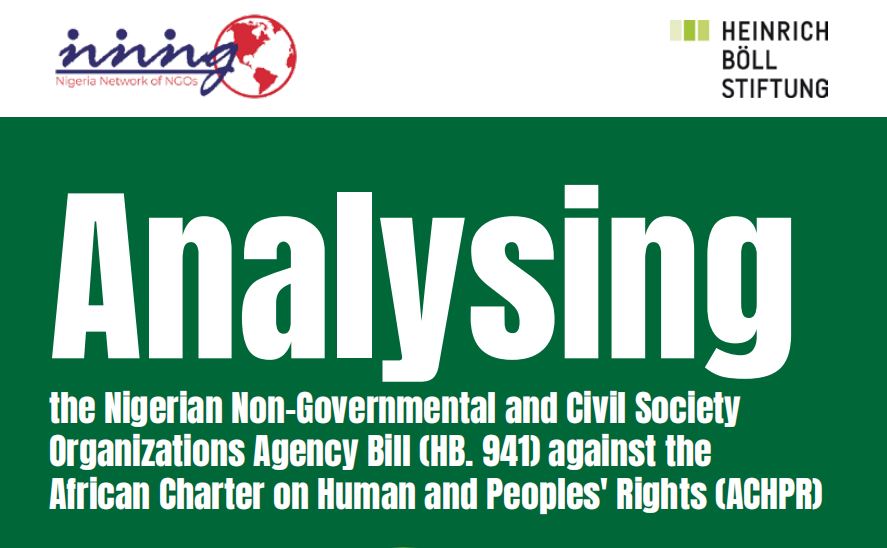
Analysing the Nigerian Non-Governmental and Civil Society Organizations Agency Bill (HB. 941) against the African Charter on Human and Peoples’ Rights (ACHPR)

Honourable Sada Soli (APC-House of Representatives) have introduced a bill that would suppress the rights of citizens to claim their freedom of association as guaranteed by the Nigerian Constitution. The title of the Bill, Nigerian Non-Governmental and Civil Society Organisations Agency Bill (HB 941), presents a comprehensive regulatory framework intended to govern the existence and operation of “Non-Governmental Organisations (NGOs) and Civil Society Organisations (CSOs) in Nigeria. The stated objective of the Bill includes ensuring transparency and accountability (S.7(b)), however the provisions within the document as analysed reveals a fundamental undermining of the constitutional and international right to freedom of association.


Fill this form to download Analysing the Nigerian Non-Governmental and Civil Society Organizations Agency Bill (HB. 941) against the African Charter on Human and Peoples' Rights (ACHPR) Report


NNNGO Annual General Meeting 2025: Strengthening Governance, Accountability, and Sector Resilience

NNNGO Annual General Meeting 2025: Strengthening Governance, Accountability, and Sector Resilience

NNNGO Annual Conference and AGM

November 12, 2025 – Lagos, Nigeria.

  • Theme: Advancing Solutions and Institutional Support for the Nonprofit Sector

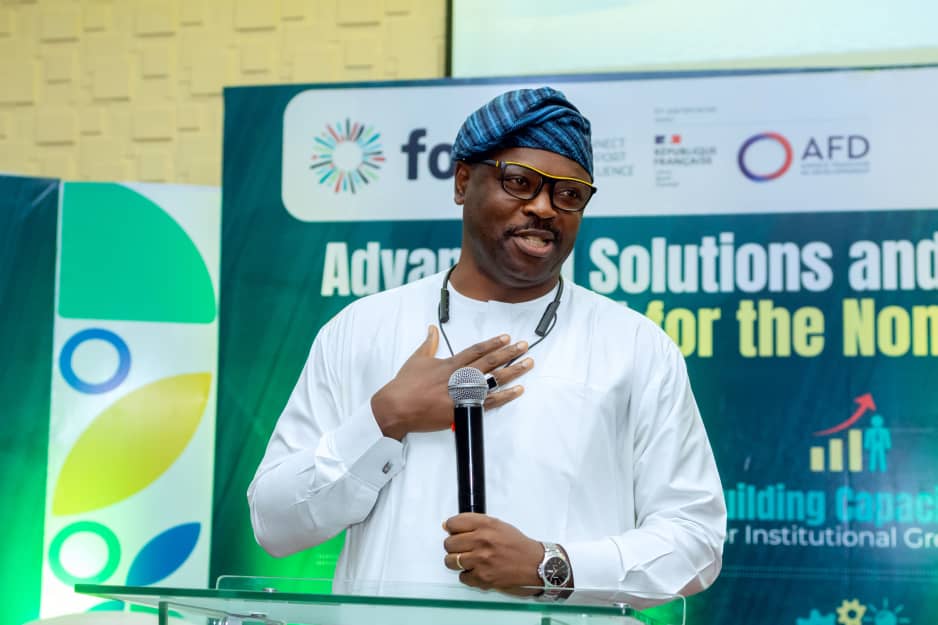
The Nigeria Network of NGOs held its Annual General Meeting (AGM) on November 12, 2025, as part of the Network’s flagship Annual Conference in Lagos. The session, during which Mr. Oyebisi Babatunde Oluseyi, Executive Director, NNNGO, formally reported the activities of the Network, provided members with key updates on governance, institutional reforms, regulatory developments, and the strategic direction for the coming year.

A Stronger Board for a Stronger Sector

In his opening remarks, Oyebisi reflected on the onboarding of new Board Members earlier in March 2025. He noted that the strengthened Board made up of seasoned professionals and sector leaders – positions the Network to deliver more effectively on its mandate, particularly as NNNGO implements its new Strategic Plan.

According to recent research conducted by the NEAR Network, NNNGO has emerged as the most mature and advanced civil society network in Africa, a milestone that lauds the Network’s credibility and long-standing commitment to institutional excellence. Oyebisi emphasised that this success belongs to the members. Further noting and stressing the strength of NNNGO – “With our analysis of 178 member budgets out of 4,060 organisations, we documented a combined value of ₦1 billion. If we assessed the full membership, we would be looking at a potential ₦1 trillion contribution to the Nigerian economy. This is the strength of our Network.”

Defending the Sector: Regulatory Advocacy and Compliance Preparedness

One of the most significant areas of focus at the AGM was the increasing regulatory pressure on nonprofits in Nigeria.

Mr. Oyebisi highlighted NNNGO’s tireless advocacy to “defending the sector 110%” in engagements with: The Corporate Affairs Commission, The Federal Inland Revenue Service, and emerging tax and compliance frameworks. With Nigeria’s new tax law tightening scrutiny on nonprofit financial transactions, Oyebisi stressed that 2026 will usher in an era of stricter regulations. He warned that nonprofits must be fully prepared: File annual returns consistently; Pay PAYE for staff; Pay Withholding Tax (WHT) for consultants; Keep accurate receipts and financial documentation; Maintain transparent accounting systems; Understand VAT obligations on non-exempt items. (Penalties now range from ₦50,000 to ₦100,000, particularly affecting organisations unknowingly operating outside compliance)

He also noted that If running a nonprofit becomes too burdensome, it is wise to pause and reconsider. “If it will be a burden for you to run a Nonprofit, please close shops,  it’s not to scare you, but because we all know the economy is not as prosperous, if you can only help 50 or 10 beneficiaries, do so and close your eyes.”

He added that NNNGO is already exploring discussions around possible tax amnesty for the sector, especially for small and emerging organisations.

Strengthening Systems to Enhance Member Access to Funding

Looking ahead, Mr. Oyebisi announced plans to establish strong, functional internal systems that will help member organisations improve their capacity, governance, financial systems, and grant-readiness.

This initiative aims to position NNNGO members to secure funds from leading national and international funding organisations by meeting global compliance and reporting standards.

Civil Society Recognition: Sustaining Influence at the Global Level

The AGM also touched on the evolving relationship between civil society and global governance institutions.

While civil society voices face declining acceptance in some international spaces, NNNGO continues to champion strong representation. Mr. Oyebisi cited the organisation’s advocacy at the United Nations, including engagements involving the UN Secretary-General – where the Network emphasized the need for inclusive civil society participation in global decision-making processes.

This, he said, remains a core pillar of NNNGO’s work: ensuring Nigerian civil society stays visible, respected, and influential on the global stage.

A Network Strengthened by Its Members

In closing, Mr. Oyebisi Babatunde Oluseyi expressed deep gratitude to NNNGO’s partners, donors, and member organisations whose contributions sustain the Network’s work. “Because of you, we are the Nigeria Network of NGOs. Without your commitment, we cannot do what we do. This Network is strong because you are strong.”

The AGM reaffirmed NNNGO’s commitment to strengthening governance, enhancing institutional support, navigating regulatory shifts, and driving sustainable growth across Nigeria’s nonprofit ecosystem.

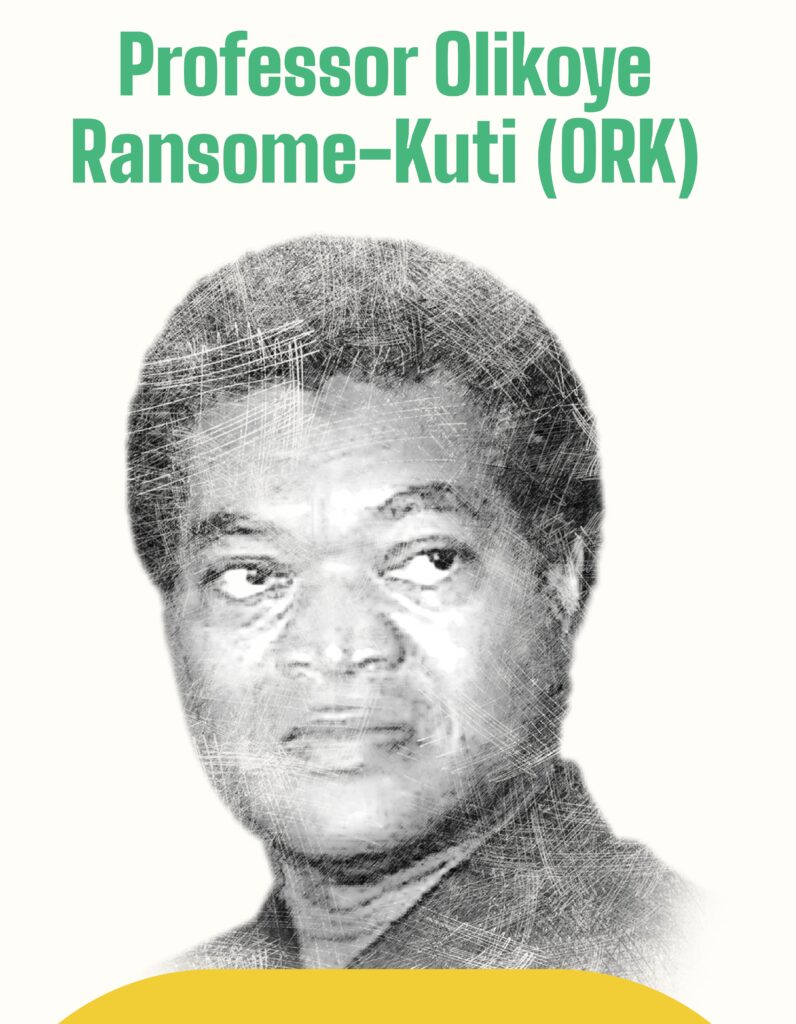
NNNGO Annual Conference Fireside Chat: Honouring the Life and Legacy of Prof. Olikoye Ransome-Kuti

NNNGO Annual Conference Fireside Chat: Honouring the Life and Legacy of Prof. Olikoye Ransome-Kuti

NNNGO Annual Conference 2025

November 12, Lagos, Nigeria.

Theme: Advancing Solutions and New Institutional Support for the Nonprofit Sector

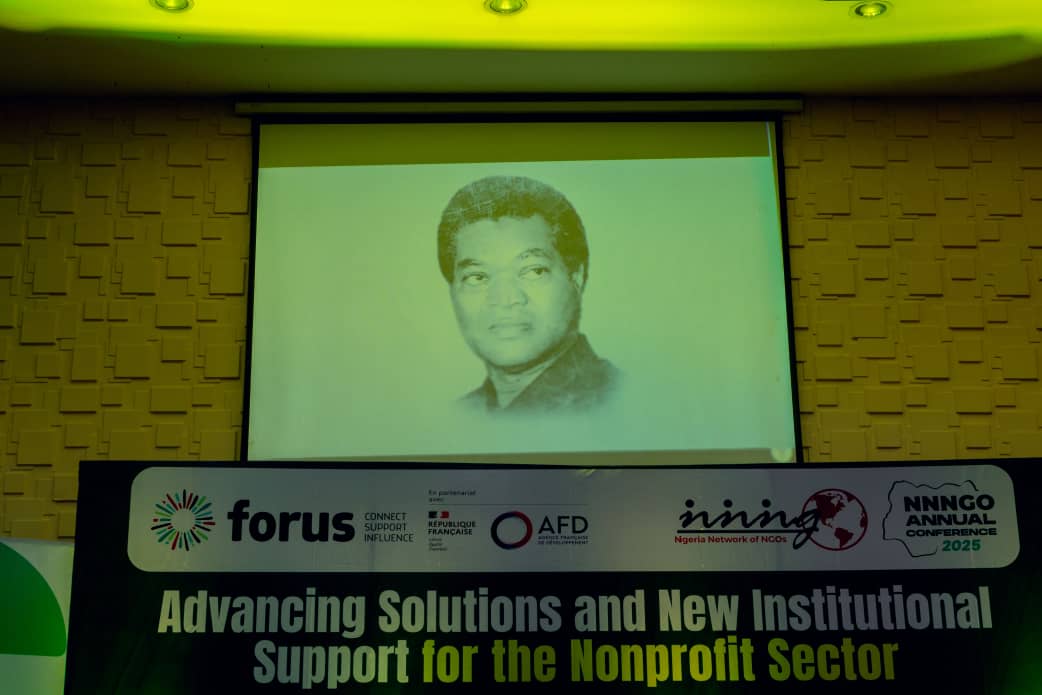
As part of the 2025 Annual Conference of the Nigeria Network of NGOs (NNNGO), a heartfelt fireside chat was convened to reflect on the extraordinary life, values, and enduring influence of Professor Olikoye Ransome-Kuti, Nigeria’s iconic public health advocate and the founding Chairman of the Network.

The conversation, moderated by Ms. Aderonke Oyelakin, Executive Director of Bimbo Odukoya Foundation, brought together two individuals deeply connected to his legacy: Ms. Yemisi Ransome-Kuti, Board Member and Founding Executive Director, NNNGO.

Dr. Abiola Tilley-Gyado, Board Member, NNNGO

More than twenty-two years after his passing, Prof. Olikoye’s imprint on Nigeria’s health and development landscape remains unmistakable. His leadership helped shape policies, strengthen institutions, and build bridges between government, civil society, and international actors, paving the way for the establishment of NNNGO in 1992.

A Legacy Rooted in Integrity, Collaboration, and People-Centred Leadership

In line with this year’s theme – Advancing Solutions and New Institutional Support for the Nonprofit Sector, the session emphasised how Prof. Olikoye’s work serves as a blueprint for strengthening the third sector.

He embodied a style of leadership that was: Visionary, long before institutional strengthening became a development priority. Accountable, always prioritizing communities over politics. People-centred, ensuring no one, especially children was left behind. His commitment to collaboration laid the foundation for the Network’s formation, demonstrating that development thrives when individuals and organisations work together with trust and shared purpose.

“Uncle Koye”: A Personal Reflection from Yemisi Ransome-Kuti

In a moving tribute, Ms. Yemisi Ransome-Kuti described Prof. Olikoye not just as a national figure, but as a warm, relatable, deeply principled human being whom everyone fondly called “Uncle Koye.”

She painted a portrait of a man who was: Remarkable, humble, and compassionate. Disciplined and morally grounded. Deeply supportive, not through financial means but through wise counsel and staunch protection, who was dedicated to Nigerian culture and made-in-Nigeria brands.

His love for humanity, especially children shaped his calling as a pediatrician and later defined his contributions to national public health reform.

She further emphasized that NNNGO was born out of collaboration, a value Prof. Olikoye championed throughout his life. Many early collaborators “dropped off” because they could not work collectively, she noted, stressing the importance of nurturing: Collective action, Trust, and Transparency.

These, she affirmed, are the pillars that enabled NNNGO to grow into the vast network it is today, and the values the sector must continue to strengthen, especially at state and local government levels.

Preserving Humanity in Health: Insights from Dr. Abiola Tilley-Gyado

Offering another dimension to Prof. Olikoye’s legacy, Dr. Abiola Tilley-Gyado reflected on his character as a leader defined by: trustworthiness, accessibility, Integrity, and passion for service. These qualities, she says – earned him public respect and eventually the position of Minister of Health.

Dr. Tilley-Gyado challenged today’s healthcare workers and development actors to ask themselves: “How accessible are you to the communities you claim to serve?”

She highlighted Prof. Olikoye’s conviction that no one should be left behind, whether due to age, vulnerability, poverty, or social exclusion. This belief guided many of his initiatives, particularly during the emergence of HIV/AIDS in Nigeria.

She recounted how Prof. Olikoye entrusted her to lead the National AIDS Control Programme, emphasizing preparedness, advocacy, and proactive collaboration. His leadership resulted in: Federal approval for state governments to allocate ₦1 million annually to AIDS control, and Local governments budgeting ₦500,000 for the same purpose; Nationwide campaigns to dispel myths, reduce stigma, and mobilize effective community response.

Through these efforts, Olikoye demonstrated how small beginnings, supported by strong planning and integrity, can evolve into transformative national movements.

A Model for the Future of Nigeria’s Third Sector

The fireside chat concluded with a reflection:

As Prof. Olikoye’s legacy is more than history is indeed a roadmap.

His values speak directly to the challenges and opportunities of today’s nonprofit ecosystem, which are: Strengthening collaboration across sectors; Building systems that are resilient and responsive; Embracing locally owned solutions; Centering humanity in all development efforts; Leading with honesty, passion, compassion, and courage

As Nigeria’s nonprofit landscape continues to evolve, the life and work of Prof. Olikoye Ransome-Kuti remain a guiding light, a light in sustainable development, that begins with integrity, collaboration, and community participation.

NNNGO Annual Conference – Plenary Session: Advancing Solutions and New Institutional Support for the Nonprofit Sector

NNNGO Annual Conference – Plenary Session: Advancing Solutions and New Institutional Support for the Nonprofit Sector

NNNGO Annual Conference 2025
November 12, Lagos, Nigeria. 

The Nigeria Network of NGOs hosted an insightful plenary session at its 2025 Annual Conference, themed “Advancing Solutions and New Institutional Support for the Nonprofit Sector.” The session convened leading voices in philanthropy, youth development, foundations, and nonprofit leadership to explore how localisation, philanthropy, and volunteerism can work together to transform Nigeria’s development landscape.

The discussion was moderated by Ms. Oyindamola Aramide, Senior Programme Officer at the Nigeria Network of NGOs, who set the tone by emphasizing the urgency of strengthening systems that enable nonprofits to deliver sustainable societal impact.

Distinguished Panelists:

Ms. Mosun Layode, Executive Director, African Philanthropy Forum

Ms. Solape Fayemi, CEO, SohcahToa Foundation

Mr. Oje Ivagba, Program Director, Ishk Tolaram Foundation

Mr. Joshua Alade, Executive Director, Nigeria Youth SDGs Network

Together, they unpacked the evolving realities of the nonprofit ecosystem and shared actionable insights on how meaningful support can be scaled across communities.

Key Insights From the Conversation

  1. Localisation as the Pathway to Sustainable Impact

Panelists agreed that local actors are central to driving effective and context-specific solutions. They highlighted the need for increased investment in community-based organisations who possess the cultural understanding, trust, and long-term commitment required to solve complex development challenges.

  1. Philanthropy Must Become More Inclusive and Strategic

Ms. Layode stressed on the importance of building a stronger culture of giving in Africa, encouraging philanthropists, private sector players, and everyday citizens to support social causes, with data-driven philanthropy, transparency, and collaboration to ensure that resources reach the organisations best positioned to make impacts.

  1. Volunteerism as a Catalyst for Social Change

From youth-led initiatives to cross-sector partnerships, the session drew on how volunteerism remains a powerful tool for mobilising communities, amplifying nonprofit reach, and nurturing future leaders. Mr. Alade highlighted the growing momentum of youth engagement as a mechanism for achieving the Sustainable Development Goals.

  1. Innovative, People-Centred Approaches Are Key

The speakers called for adaptive systems, flexible funding mechanisms, and supportive institutional policies that allow nonprofits to thrive. Strengthening organisational capacity, improving governance structures, and leveraging technology were also identified as important pathways for building a resilient nonprofit ecosystem.

A Collective Call to Action

The plenary session reinforced a shared understanding: Nigeria’s development challenges require coordinated, community-led, and innovative solutions. By strengthening localisation, promoting a culture of philanthropy, and expanding opportunities for volunteerism, stakeholders can drive lasting social change and enhance the effectiveness of the nonprofit sector.

As the nonprofit landscape continues to evolve, the NNNGO remains committed to convening leaders, fostering collaboration, and enabling organisations to build stronger systems for greater impact.


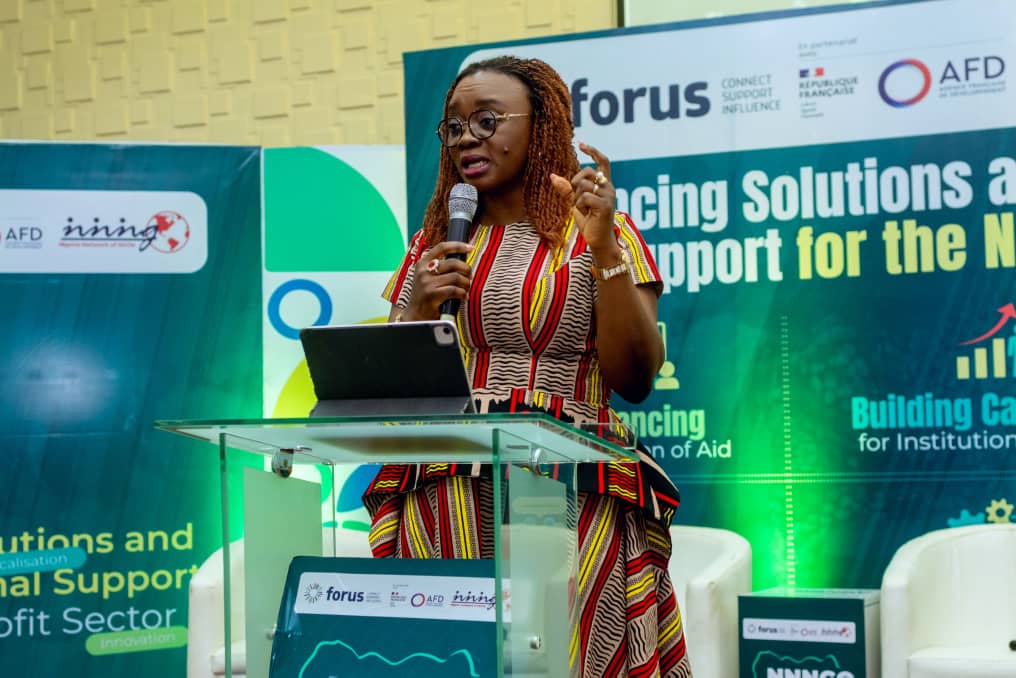
Toyin Akinniyi Delivers High-Powered Keynote on Reimagining Institutional Support for Nigeria’s Nonprofit Sector at the NNNGO Annual Conference 2025.

Toyin Akinniyi Delivers High-Powered Keynote on Reimagining Institutional Support for Nigeria’s Nonprofit Sector at the NNNGO Annual Conference 2025.

At the 2025 Annual Conference of the Nigeria Network of NGOs, November 12th in Lagos, Toyin Akinniyi, Vice President Africa, Luminate, delivered a deeply moving and forward-looking keynote address under the theme: “Advancing Solutions and New Institutional Support for the Nonprofit Sector.”

Her speech, rich with history, personal reflection, and sector-wide insight, stresses on how far Nigeria’s civic space has come and a call to action for what must be strengthened next.

Rooted in Place, Community, and Context

Akinniyi began by grounding her message in the power of context, emphasizing that solutions for the nonprofit sector must be “deeply rooted in place, in community, and in context.”

Reflecting on her identity as a Nigerian, she drew a poignant memory of the nation’s not-so-distant past under military rule. During that era, she recounted, journalism became a courageous act of resistance against information blackouts, and civil society activism was fraught with restrictions.

“About 30 years ago,” she noted, “freedom of expression and the ability of civil society to organize, demand accountability, and push back against repression were distant realities.”

Yet, from that difficult period emerged the media resilience and civil society collectives that protect Nigeria’s democratic space today. It was a hard-won freedom born not from institutions, but from people who dared to act.

Challenges Persist, But So Does Hope

Akinniyi was clear that the intention of her reflection was not to romanticize the past or imply that contemporary civic space challenges mirror exactly what came before. Instead, she used history as a lens to remind the sector of its enduring resilience.

Today’s nonprofit ecosystem, she noted, faces significant hurdles: shrinking civic space, capacity gaps, trust deficits, and continued funding limitations, including one particularly significant funding setback in 2024/2025.

Yet, she emphasized that despite these obstacles, Nigeria’s nonprofit sector has never stopped moving forward.

“Through all of this,” she said, “the sector will thrive. We must remain internal optimists and learners.”

Her call: Begin by acknowledging what is working.

What’s Working Across Africa’s Nonprofit Landscape

Akinniyi spotlighted emerging and encouraging trends reshaping the sector:

1. A New Generation of Networked, Collaborative Organizations. Across Africa, younger organizations are rising – more connected, more agile, and more inclined toward collaboration than competition.

They learn across borders, engage peers, and creatively blend activism, entrepreneurship, and digital innovation.

2. A Shift Toward Trust-Based Philanthropy

Funders, including major players like Luminate are increasingly moving away from strictly project-based grants and toward flexible, core support that gives organizations the stability required to create lasting solutions.

3. The Rise of Domestic Philanthropy.

Local giving is becoming a formidable force. According to the 2023 African Giving Report, Africans contributed approximately USD 2 billion annually to charitable causes, most of it driven by individual giving.

New 2025 findings from the World Giving Index revealed:

Africans donate 1.5% of their income on average the highest globally.

In Nigeria, individuals donate 2.8% of their income.

“This proves something profound,” she remarked.

“Philanthropy already lives among us. It is happening every day, across faith spaces, families, and communities.”

4. Growing Recognition of NGOs as System Shapers.

More global actors are beginning to acknowledge NGOs not merely as service providers, but as movement builders and system shapers essential to sustainable development.

This shift in narrative signals a more dignified and accurate understanding of the sector’s role.

But Significant Gaps Remain

Akinniyi noted that many positive developments are occurring in spite of systemic constraints – not because enabling structures exist.

Hence for nonprofits to thrive, institutional investment must evolve, civic freedoms must be protected, funding must be more reliable, and long-term sector strengthening must become a shared priority.

A Strong and Resilient Sector-Ready for the Future

Closing her speech, Akinniyi offered a hopeful and inspiring reflection: “In 2025, we have built a strong sector, strong enough to dream, and resilient enough to deliver.”

Her words captured the essence of the conference theme: the urgent need to advance solutions while creating new, more enabling forms of institutional support that meet the realities of Nigeria Nonprofits today.

The NNNGO Annual Conference 2025 provided the perfect platform for this conversation, reminding stakeholders that the power to transform systems lies not only in structures but in people, their vision, collaboration, and staunch optimism.
Nonprofit Tax Regulation in the Nigeria Tax Administration Act (NTAA), 2025.

The Nigeria Tax Administration Act (NTAA) 2025, signals the Federal Government of Nigeria’s intention to streamline and harmonise administrative procedures across state and federal tax legislations. The objectives of the Act, articulated in Section 1, to “facilitate tax compliance by taxpayers” and, critically, to “optimise tax revenue”.

Traditionally, nonprofit organisations enjoy tax-exemption status on their income (revenue) such as grants, donations and subscriptions, the NTAA 2025 from our initial understanding at the Nigeria Network of NGOs places a fundamental shift in compliance focus on the sector.

Complete this form to download the Nonprofit Tax Regulation in the Nigeria Tax Administration Act (NTAA), 2025. Report


The Nigeria Network of NGOs (NNNGO) is the first generic membership body for civil society organisations in Nigeria that facilitates effective advocacy on issues of poverty and other developmental issues. Established in 1992, NNNGO represents over 3495 organisations ranging from small groups working

Do you have questions? Call or visit us.

+2349069460107

Plot 3 Sobanjo avenue, Idi-ishin Jericho Ibadan, Oyo, Nigeria.

15 Ramat Crescent, Ogudu GRA, Lagos, Nlgeria

nnngo@nnngo.org 

Newsletter

Get latest news & update

Connect With Us

© 2025 – Nigeria Network of NGO (NNNGO). All rights reserved.

Follow us on social media