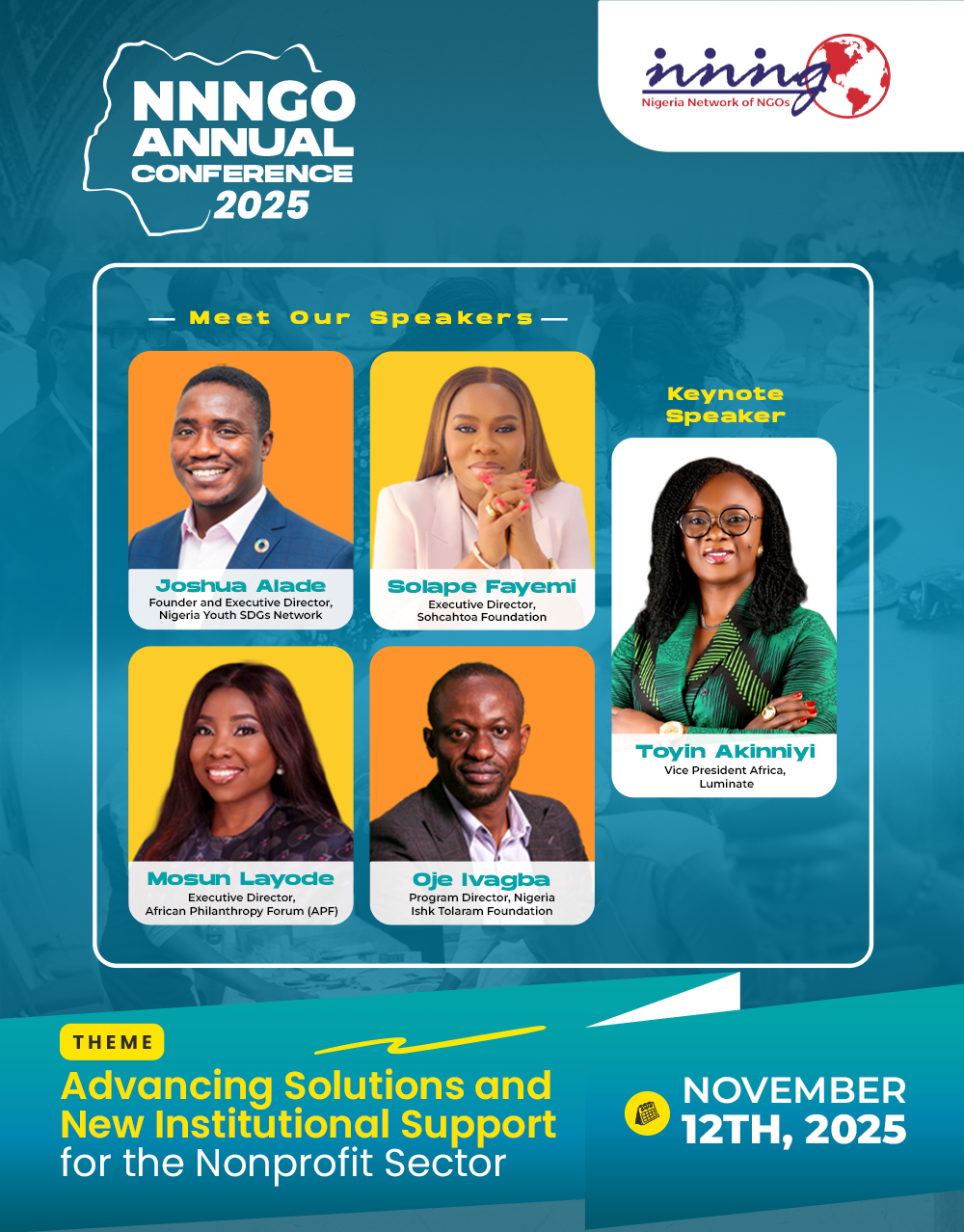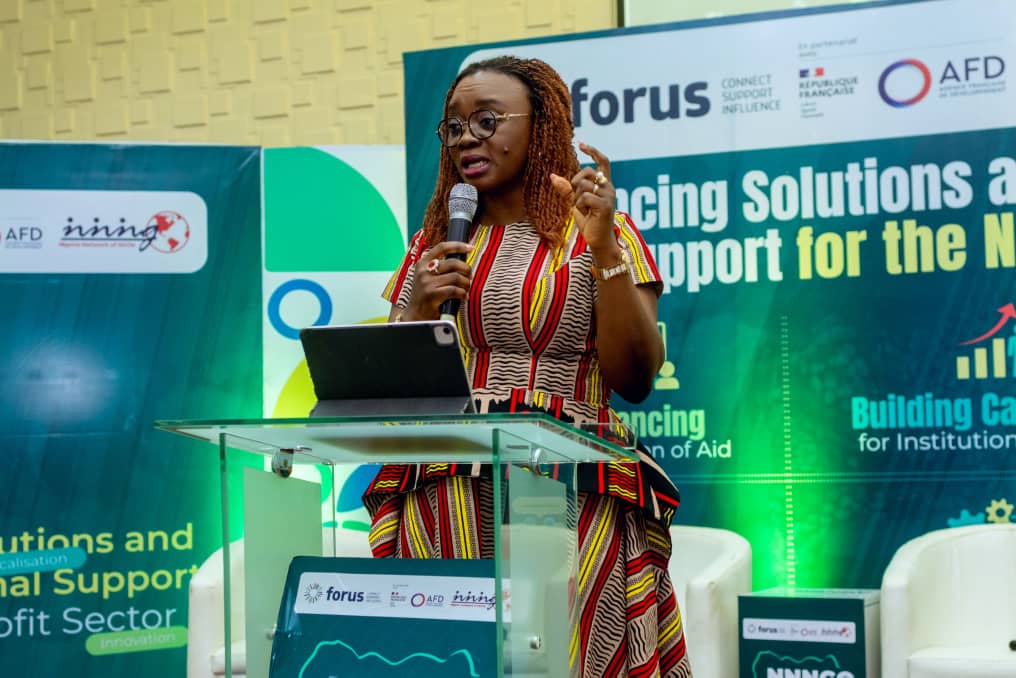
Toyin Akinniyi Delivers High-Powered Keynote on Reimagining Institutional Support for Nigeria’s Nonprofit Sector at the NNNGO Annual Conference 2025.

Toyin Akinniyi Delivers High-Powered Keynote on Reimagining Institutional Support for Nigeria’s Nonprofit Sector at the NNNGO Annual Conference 2025.

At the 2025 Annual Conference of the Nigeria Network of NGOs, November 12th in Lagos, Toyin Akinniyi, Vice President Africa, Luminate, delivered a deeply moving and forward-looking keynote address under the theme: “Advancing Solutions and New Institutional Support for the Nonprofit Sector.”

Her speech, rich with history, personal reflection, and sector-wide insight, stresses on how far Nigeria’s civic space has come and a call to action for what must be strengthened next.

Rooted in Place, Community, and Context

Akinniyi began by grounding her message in the power of context, emphasizing that solutions for the nonprofit sector must be “deeply rooted in place, in community, and in context.”

Reflecting on her identity as a Nigerian, she drew a poignant memory of the nation’s not-so-distant past under military rule. During that era, she recounted, journalism became a courageous act of resistance against information blackouts, and civil society activism was fraught with restrictions.

“About 30 years ago,” she noted, “freedom of expression and the ability of civil society to organize, demand accountability, and push back against repression were distant realities.”

Yet, from that difficult period emerged the media resilience and civil society collectives that protect Nigeria’s democratic space today. It was a hard-won freedom born not from institutions, but from people who dared to act.

Challenges Persist, But So Does Hope

Akinniyi was clear that the intention of her reflection was not to romanticize the past or imply that contemporary civic space challenges mirror exactly what came before. Instead, she used history as a lens to remind the sector of its enduring resilience.

Today’s nonprofit ecosystem, she noted, faces significant hurdles: shrinking civic space, capacity gaps, trust deficits, and continued funding limitations, including one particularly significant funding setback in 2024/2025.

Yet, she emphasized that despite these obstacles, Nigeria’s nonprofit sector has never stopped moving forward.

“Through all of this,” she said, “the sector will thrive. We must remain internal optimists and learners.”

Her call: Begin by acknowledging what is working.

What’s Working Across Africa’s Nonprofit Landscape

Akinniyi spotlighted emerging and encouraging trends reshaping the sector:

1. A New Generation of Networked, Collaborative Organizations. Across Africa, younger organizations are rising – more connected, more agile, and more inclined toward collaboration than competition.

They learn across borders, engage peers, and creatively blend activism, entrepreneurship, and digital innovation.

2. A Shift Toward Trust-Based Philanthropy

Funders, including major players like Luminate are increasingly moving away from strictly project-based grants and toward flexible, core support that gives organizations the stability required to create lasting solutions.

3. The Rise of Domestic Philanthropy.

Local giving is becoming a formidable force. According to the 2023 African Giving Report, Africans contributed approximately USD 2 billion annually to charitable causes, most of it driven by individual giving.

New 2025 findings from the World Giving Index revealed:

Africans donate 1.5% of their income on average the highest globally.

In Nigeria, individuals donate 2.8% of their income.

“This proves something profound,” she remarked.

“Philanthropy already lives among us. It is happening every day, across faith spaces, families, and communities.”

4. Growing Recognition of NGOs as System Shapers.

More global actors are beginning to acknowledge NGOs not merely as service providers, but as movement builders and system shapers essential to sustainable development.

This shift in narrative signals a more dignified and accurate understanding of the sector’s role.

But Significant Gaps Remain

Akinniyi noted that many positive developments are occurring in spite of systemic constraints – not because enabling structures exist.

Hence for nonprofits to thrive, institutional investment must evolve, civic freedoms must be protected, funding must be more reliable, and long-term sector strengthening must become a shared priority.

A Strong and Resilient Sector-Ready for the Future

Closing her speech, Akinniyi offered a hopeful and inspiring reflection: “In 2025, we have built a strong sector, strong enough to dream, and resilient enough to deliver.”

Her words captured the essence of the conference theme: the urgent need to advance solutions while creating new, more enabling forms of institutional support that meet the realities of Nigeria Nonprofits today.

The NNNGO Annual Conference 2025 provided the perfect platform for this conversation, reminding stakeholders that the power to transform systems lies not only in structures but in people, their vision, collaboration, and staunch optimism.
Nonprofit Tax Regulation in the Nigeria Tax Administration Act (NTAA), 2025.

The Nigeria Tax Administration Act (NTAA) 2025, signals the Federal Government of Nigeria’s intention to streamline and harmonise administrative procedures across state and federal tax legislations. The objectives of the Act, articulated in Section 1, to “facilitate tax compliance by taxpayers” and, critically, to “optimise tax revenue”.

Traditionally, nonprofit organisations enjoy tax-exemption status on their income (revenue) such as grants, donations and subscriptions, the NTAA 2025 from our initial understanding at the Nigeria Network of NGOs places a fundamental shift in compliance focus on the sector.

Complete this form to download the Nonprofit Tax Regulation in the Nigeria Tax Administration Act (NTAA), 2025. Report


Nonprofit Regulations in the Nigeria Tax Act, 2025.

Our Initial Understanding at the Nigeria Network of NGOs

The Nigeria Tax Act signed into law June 26, 2025, with commencement date set for January 2026 necessitates a fundamental shift in how nonprofit organisations engages tax regulation and compliance. A high point of the law is the consolidation of multiple tax laws into a single, extensive fiscal framework.

Complete this form to download the Nonprofit Regulations in the Nigeria Tax Act, 2025. report


Fifty (50) Tax Exemptions and Reliefs in the Nigeria Tax Act 2025 that benefits Nonprofit Organisations and staff.

The table below provides broad based overview of how each of the fifty exemptions and reliefs in the Nigeria Tax Act 2025 strategically supports Nigerian nonprofits operations across human resources, programme and capital management domains. The Nigeria Network of NGOs has developed this comprehensive table as framework for nonprofit organisations to understand and plan for these exemptions and reliefs in their work.


Complete this form to download the Fifty (50) Tax Exemptions report


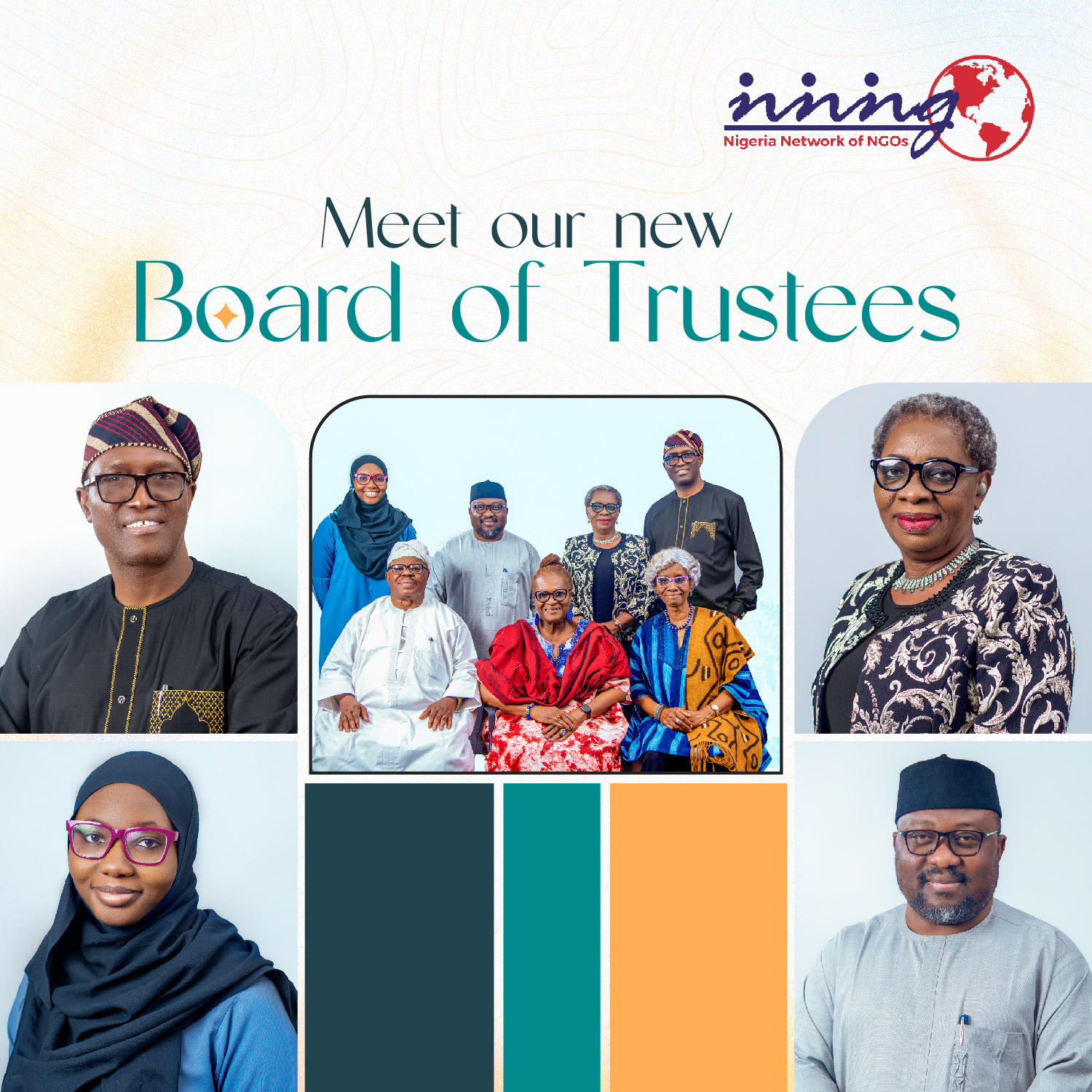
NNNGO Appoints New Board Members to Strengthen Governance and StrategicGrowth

Welcoming New Trustees onto the Board

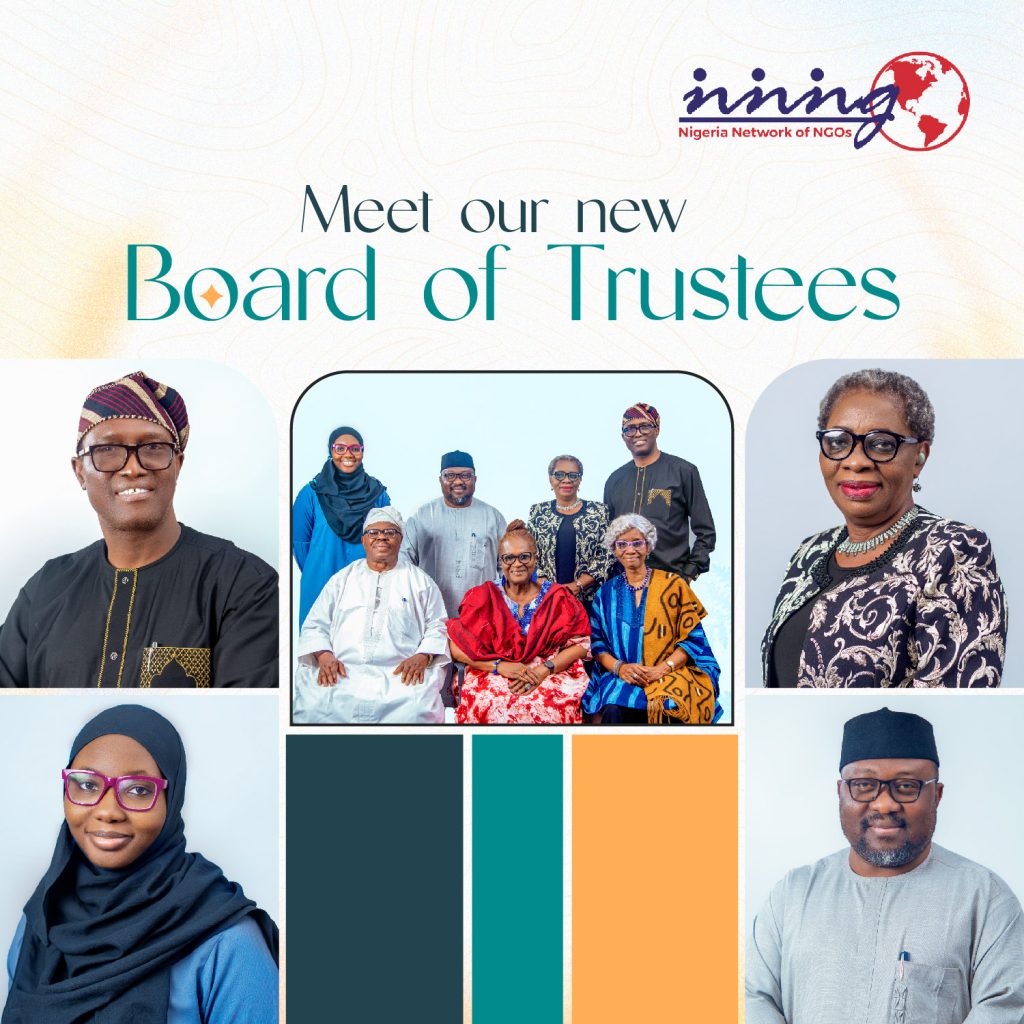
NNNGO welcomes Dr Eugene Itua, Dr Gladys Ihunda, Dr Hassana Shuaibu and Alhaji Habib Isa Dutse to its Board of Trustees. They join Mr Femi Lijadu, Ms. Yemisi Ransome-Kuti, Dr Abiola Tilley-Gyado, Ms. Shade Bembatoum-Young and Otunba Dele Ajayi-Smith, long time members of the board of trustees of NNNGO.

These new members bring a wealth of experience and expertise that will enhance the Network’s mission to strengthen sector governance, support civil society organisations in navigating a challenging economic landscape and promote sustainable development in Nigeria.

Dr Eugene Itua is an environmental sustainability expert, CEO, Natural Eco Capital and the National Project Coordinator for the elaboration of Nigeria’s Long-Term Low Emissions Development Strategy (LT-LEDS). He is also the Regional Coordinator for the West Africa Capitals Hub and has served as the Policy & Advocacy Coordinator for Natural Capital in African Development Finance (NC4 ADF), an initiative by AfDB and the Green Growth Knowledge Partnership. His expertise will aid NNNGO’s new strategic priority of promoting the climate change discourse.

Dr Gladys Ihunda is the Acting Secretary/Registrar at West Africa Health Examinations Board. She attended Houdegbe North American University Benin and has had a long career working at the Federal Ministry of Health, Nigeria to improve healthcare in Nigeria.As NNNGO’s first program officer at its inception, she brings institutional knowledge with expertise from working in the Nigerian public sector to support NNNGO’s engagements with government and other relevant stakeholders.

Dr Hassana Shuaibu is a senior program officer at ACE Charity who has a BSc in Human Anatomy and an MSc in Public Health and completed her PhD program in Community Education and Development. Her experience will support NNNGO’s goal to encourage more youth participation in its leadership.

Alhaji Habib Isa Dutse is a highly experienced banking and finance professional with over three decades of experience in the industry. A dedicated and established achiever in the Banking & Finance sector with great knowledge of business processes, administration and economic weathers. With a strong track record of success in various roles, including Investment Banking, Risk Management, Financial Analysis, Human Capital Management and development. He will provide NNNGO with valuable insights garnered from his years of experience in the private sector.

Ms. Yemisi Ransome-Kuti, speaking for the board, at the just concluded annual board retreat welcomed the appointments, stating:

“We are pleased to welcome our new trustees who bring invaluable skills and experience to our board. Their insights will help us navigate a changing landscape and ensure that NNNGO continues to provide robust support to nonprofits across Nigeria”

Speaking on the appointments, Oyebisi Oluseyi, Executive Director of NNNGO, stated:

“We are thrilled to welcome these accomplished professionals to our Board. Their collective experience in governance, policy advocacy, and nonprofit management will be invaluable in guiding NNNGO’s strategic direction. As we continue to drive positive change in Nigeria’s civil society space, their leadership will help us strengthen our impact and sustainability.”

The new board members will support NNNGO’s ongoing efforts to improve nonprofit sector effectiveness, enhance transparency and accountability, and foster collaboration among civil society organisations (CSOs) in Nigeria. We remain committed to promoting a vibrant, resilient, and well-governed nonprofit sector that contributes to national development.

Technical Issues in Donor Agencies Regulatory Commission Bill HB 1568

This report analyses various issues in the Donor Agencies Regulatory Commission Bill HB 1568 and makes recommendations that the law hould be dropped.


The importance of civil society is reflected by the significant grants and donations made to them
by different stakeholders and actors within the development ladder ranging from individualseveryday Nigerians, corporate organisations, philanthropists, foundations, and multilateral organisations.


There has been significant legislative interest relating to civil society regulations since the 6th Assembly. These regulatory attempts though pushed back by civil society focused on narratives such as national security, prevention of terrorism financing, corruption,and lack of regulations. While the issues framed by these narratives are relevant and of concern to the civil society sector, to balance regulation against proper protection of institutions within civil society, none of these issues have been investigated or evidenced.

Kindly fill this form to download the Technical Issues in Donor Agencies Regulatory Commission Bill HB 1568


GUIDE ON COMPLYING WITH THE PART F OF CAMA

Nonprofit governance has been in the spotlight in the last few years with increased interest in regulatory
compliance. The Part F of the Companies and Allied Matters Act (CAMA) is the law guiding the formation and governance of nonprofits in Nigeria. This document is our attempt to provide a framework for improving nonprofit compliance with the Part F of CAMA. Our theory of change is centered on the assumption that good nonprofit governance serves as a strong foundation for an efficient nonprofit sector. In this document we have placed strong emphasis on how nonprofits can achieve each clause in the law, rationale for meeting them and key outcomes for the nonprofit sector.


This document is an important piece of guidance that nonprofit trustees and managers need to be familiar with. It draws on the legal requirements, established best practices and principles designed to challenge nonprofits to improve their governance and to ensure necessary systems and processes are in place in their various organisations to comply with regulations guiding the operations of nonprofits in the country, thereby helping them keep a focus on their purpose (objects).

Kindly fill this form to download the GUIDE ON COMPLYING WITH THE PART F OF CAMA


Precautionary Regulatory Measures

Imagine that you have just received a telephone call that a political aspirant or sitting elected official wants to give your nonprofit money to organise charitable activities for your target audience. You have always made a difference in your community and you want to do more. You think this money could be put to good use.


Because of this information you have received, you call your staff to start thinking of ideas, you are already excited and planning to meet with your potential donor. You have heard it that individual giving is the most sustainable source of funding for nonprofits.


The Nigeria Network of NGOs has prepared this advisory note to help you steer the course of receiving funding from politicians and political aspirants around this period. With the national elections around the corner, trends from the 2015 general elections saw politicians and their supporters providing support to nonprofits to hold events where aspirants can speak to large audiences or to demonstrate their
kindness and generosity to disadvantaged communities.

Kindly fill this form to download the PRECAUTIONARY REGULATORY MEASURES


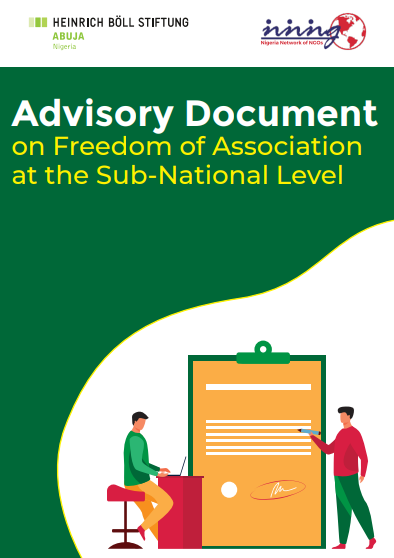
Advisory Document on Freedom of Association at the Sub-National Level

This advisory document is designed to provide guidance to sub-national governments and regulators within Nigeria on the critical issue of freedom of association at the sub-national level. It outlines the importance of protecting this fundamental right and offers recommendations for promoting a conducive environment form associations, organizations, and groups to flourish.

The advisory document focuses on sub-national governments’ roles in safeguarding freedom of association, ensuring compliance with national laws, and fostering collaboration with civil society. It also provides a set of recommendations aimed at promoting and protecting this fundamental right.

Kindly fill this form to download the Advisory Document on Freedom of Association at the Sub-National Level


The Nigeria Network of NGOs (NNNGO) is the first generic membership body for civil society organisations in Nigeria that facilitates effective advocacy on issues of poverty and other developmental issues. Established in 1992, NNNGO represents over 3495 organisations ranging from small groups working

Do you have questions? Call or visit us.

+2349069460107

Plot 3 Sobanjo avenue, Idi-ishin Jericho Ibadan, Oyo, Nigeria.

15 Ramat Crescent, Ogudu GRA, Lagos, Nlgeria

nnngo@nnngo.org 

Newsletter

Get latest news & update

Connect With Us

© 2025 – Nigeria Network of NGO (NNNGO). All rights reserved.

Follow us on social media