Communities Become Stronger and Better Equipped, When Women Fully Participate in Civic

When women fully participate in civic life, communities become stronger and better equipped to drive sustainable development.
‎
‎Across Nigeria, women continue to demand a greater share of political seats not as a symbolic gesture, but as a matter of equity, representation, and effective governance. Despite their contributions to nation-building, women remain significantly underrepresented in elected and appointed offices, limiting the diversity of perspectives in decision-making.
‎
‎Increasing women’s political participation is not only about fairness; it is about strengthening democracy and ensuring that governance reflects the needs and aspirations of all citizens.
‎
‎In this edition of Civic Wire, we examine the state of women’s political representation in Nigeria(which is outrightly low) , the barriers that persist, and the pathways to achieving more inclusive leadership and participation for sustainable development.
‎
‎This is 𝗖𝗶𝘃𝗶𝗰 𝗪𝗶𝗿𝗲… Creating an enabling environment… Protecting the Civic Space.

Lagos, Nigeria’s technology capital

Lagos is often described as Nigeria’s technology capital, a city of startups, innovation hubs, and one of Africa’s largest digital populations. But beyond business and commerce, technology is quietly reshaping something else: how people engage with power. With Nigeria recording over 220 million active mobile subscriptions, according to the Nigerian Communications Commission, digital connectivity is opening new pathways for civic participation.
‎
‎Across Lagos, technology-driven civil society organizations are using digital tools to make governance easier to understand and harder to ignore.
‎
‎From civic tech platforms that track government budgets and monitor public projects to digital campaigns that amplify citizens’ voices and encourage public participation, technology is helping bridge the gap between government and the governed. Citizens are no longer just observers; they are becoming active participants in shaping policies, demanding accountability, and driving change.
‎
‎In this edition of Civic Wire, we explore how innovation is transforming civic engagement, and how technology is strengthening transparency, accountability, and citizen participation in Nigeria’s democracy ensuring that no one is left behind.
‎
‎𝗖𝗶𝘃𝗶𝗰 𝗪𝗶𝗿𝗲… Creating an Enabling Environment. Protecting the Civic Space.
‎
‎
‎#CallToAction
‎#CivicWire
‎#CreatingAnEnablingEnvironment
‎#ProtectingTheCivicSpace
‎#ExpressionAssociationAssembly
‎#LeavingNoOneBehind
‎#SustainableDevelopmentGoals
‎#GlobalGoals
‎

𝗢𝘆𝗲𝗯𝗶𝘀𝗶 𝗕. 𝗢𝗹𝘂𝘀𝗲𝘆𝗶 𝗖𝗵𝗮𝗹𝗹𝗲𝗻𝗴𝗲𝘀 𝗚𝟳 𝘁𝗼 𝗗𝗲𝗹𝗶𝘃𝗲𝗿 𝗼𝗻 𝗝𝘂𝘀𝘁𝗶𝗰𝗲 𝗮𝗻𝗱 𝗦𝗼𝗹𝗶𝗱𝗮𝗿𝗶𝘁𝘆 𝗮𝘁 𝗣𝗮𝗿𝗶𝘀 𝗖𝟳 𝗦𝘂𝗺𝗺𝗶𝘁

‎𝗢𝘆𝗲𝗯𝗶𝘀𝗶 𝗕. 𝗢𝗹𝘂𝘀𝗲𝘆𝗶 𝗖𝗵𝗮𝗹𝗹𝗲𝗻𝗴𝗲𝘀 𝗚𝟳 𝘁𝗼 𝗗𝗲𝗹𝗶𝘃𝗲𝗿 𝗼𝗻 𝗝𝘂𝘀𝘁𝗶𝗰𝗲 𝗮𝗻𝗱 𝗦𝗼𝗹𝗶𝗱𝗮𝗿𝗶𝘁𝘆 𝗮𝘁 𝗣𝗮𝗿𝗶𝘀 𝗖𝟳 𝗦𝘂𝗺𝗺𝗶𝘁
‎
‎Paris, France – 5 June 2026
‎
‎The Executive Director of the Nigeria Network of NGOs (NNNGO), Oyebisi Babatunde Oluseyi has called on G7 leaders to move beyond rhetoric and take decisive action to defend multilateralism, reverse aid cuts, and protect civic space.
‎
‎Earlier today, delivering a keynote remarks at the Opening Session of the Civil 7 Summit in Paris, France, Oyebisi urged world leaders to match their commitments with concrete action, emphasizing the indispensable role of civil society in addressing today’s interconnected global challenges.
‎
‎The C7 Summit, convened under the theme “Global Justice and Solidarity: Mobilizing for Change,” brings together civil society leaders from across the world to develop policy recommendations ahead of the G7 Leaders’ Summit.
‎
‎”Civil society is not an accessory to global solutions, we are at the heart of them,” Oyebisi said during his keynote address.
‎
‎𝗔 𝗗𝗲𝗳𝗶𝗻𝗶𝗻𝗴 𝗠𝗼𝗺𝗲𝗻𝘁 𝗳𝗼𝗿 𝗚𝗹𝗼𝗯𝗮𝗹 𝗚𝗼𝘃𝗲𝗿𝗻𝗮𝗻𝗰𝗲
‎Addressing international stakeholders, Oyebisi described the current global landscape as a defining test for international cooperation and governance.
‎
‎He highlighted a convergence of crises, including rising conflicts, growing humanitarian needs, worsening climate impacts, and increasing health challenges. These pressures, he noted, are occurring at a time when civic space is shrinking and development assistance is declining.
‎
‎”This is not a normal G7 year,” he said. “It is a test of whether the G7 will defend multilateralism, international law, and global solidarity in practice – not just in speeches.”
‎
‎𝗙𝗿𝗼𝗺 𝗖𝗵𝗮𝗿𝗶𝘁𝘆 𝘁𝗼 𝗝𝘂𝘀𝘁𝗶𝗰𝗲
‎Speaking from the perspective of the Global South, Oyebisi stressed that civil society’s demands extend beyond appeals for assistance.
‎
‎”We are not here to ask for charity. We are calling for justice,” he stated.
‎
‎He called on global leaders to make bold political choices that address structural inequalities, democratize global financial governance, protect human rights, and ensure that affected communities have a meaningful voice in decision-making processes.
‎
‎As the leader of the peak body for CSOs in Nigeria, Oyebisi emphasized the need to rebalance global systems that often exclude those most affected by crises.
‎
‎𝗛𝗼𝗹𝗱𝗶𝗻𝗴 𝘁𝗵𝗲 𝗚𝟳 𝗔𝗰𝗰𝗼𝘂𝗻𝘁𝗮𝗯𝗹𝗲
‎Oyebisi challenged G7 governments to align their actions with their stated commitments, drawing attention to contradictions between public declarations of support for multilateralism and policy decisions that undermine global cooperation.
‎
‎”You cannot claim to defend multilateralism while cutting aid, weakening institutions, or applying international law selectively,” he noted.
‎
‎He further noted that the G7’s significant influence over development finance, international institutions, and global policy frameworks must be matched by a corresponding commitment to responsibility and accountability.
‎
‎𝗖𝗶𝘃𝗶𝗹 𝗦𝗼𝗰𝗶𝗲𝘁𝘆 𝗮𝘀 𝗮 𝗦𝘁𝗿𝗮𝘁𝗲𝗴𝗶𝗰 𝗣𝗮𝗿𝘁𝗻𝗲𝗿
‎Drawing on the experiences of civil society organizations worldwide, Oyebisi highlighted the role CSOs play as frontliners in humanitarian response, human rights protection, community development, and accountability efforts.
‎
‎He therefore called for greater protection of civic space, flexible and sustainable funding mechanisms for civil society organizations, and institutionalized participation in global decision-making processes. “Without civil society, there is no accountability, no legitimacy, and no lasting progress,” he stressed.
‎
‎𝗔𝗱𝘃𝗮𝗻𝗰𝗶𝗻𝗴 𝗦𝗼𝗹𝘂𝘁𝗶𝗼𝗻𝘀 𝗧𝗵𝗿𝗼𝘂𝗴𝗵
‎Oyebisi’s further call aligns with the broader objectives of the C7 Summit, which is focused on advancing recommendations on the future of multilateralism, international humanitarian law, reform of global financial systems, the future of development assistance, and growing restrictions on civic space around the world.
‎The summit serves as a critical platform for civil society organizations to influence global policy discussions and contribute actionable recommendations to G7 leaders.
‎
‎𝗔 𝗖𝗹𝗲𝗮𝗿 𝗖𝗮𝗹𝗹 𝘁𝗼 𝗔𝗰𝘁𝗶𝗼𝗻
‎Closing his address, Oyebisi called on G7 leaders to:
‎👉 Reverse cuts to Official Development Assistance;
‎👉 Recommit to global solidarity targets, including the 0.7%;
‎👉 Protect civic space and fundamental human rights; and
‎👉 Promote inclusive, accountable, and effective multilateralism.
‎
‎”The world does not need another declaration of concern,” he concluded. “It needs concrete choices.”
‎
‎𝗔𝗯𝗼𝘂𝘁 𝗡𝗡𝗡𝗚𝗢
‎‎The Nigeria Network of NGOs (NNNGO) is the first generic membership body and peak organization for civil society organizations in Nigeria. NNNGO works to strengthen civil society and facilitate effective advocacy on poverty, and other developmental issues.

‎#CallToAction
‎#Civil7Summit
‎#G7Summit
‎#GlobalJusticeandSolidarity
‎#MobilisingforChange
‎#LeavingNoOneBehind
‎#SustainableDevelopmentGoals
‎#GlobalGoals

Adamawa Women Financial Inclusion Adashi Groups

For over 30 years, Monica Tumba was invisible to Nigeria’s financial system. No loans. No capital. No opportunity. Then one intervention changed everything. This powerful investigation reveals why millions of rural women remain excluded from formal finance, how traditional adashi savings circles are succeeding where banks have failed, and why economic empowerment may be the strongest weapon against poverty and humanitarian crises in northern Nigeria. 👇🏽

https://thegazette.ng/adamawa-women-financial-inclusion-adashi-groups

WomenEmpowerment #FinancialInclusion #AdamawaState #RuralWomen #Microfinance #EconomicResilience #PovertyReduction #GenderEquality #NNNGOFellowship #TheGazetteNewsNigeria

Civil Society RegulatoryFrameworksin Nigeria

The purpose of this research is to better understand the current landscape of civil society regulations in Nigeria, contribute to and bring knowledge to national conversations on civil society regulations and examine best practices and tools for self-regulation.

Fill this form to download te document above


2025 Budget Speech and the SDGs

On December 19, 2025, President Bola Ahmed Tinubu presented Nigeria’s 2026 Appropriation Bill, titled “Budget of Consolidation, Renewed Resilience and Shared Prosperity,” to a joint session of the National Assembly in Abuja.

Valued at approximately ₦58.18 trillion, the budget builds on two-and-a-half years of economic reforms aimed at stabilizing the macroeconomy amid challenges like inflation and residual effect of the subsidy removal. Key priorities of the 2025 budget include national security (₦5.41 trillion), infrastructure (₦3.56 trillion), education (₦3.52 trillion), health (₦2.48 trillion), and agriculture for food security and climate resilience.


Kindly fillthis form to downalod the 2025 Budget Speech and the SDGs


2025 in Review: Strengthening Civil Society Across Nigeria and Beyond

2025 in Review: Strengthening Civil Society Across Nigeria and Beyond

‎‎In 2025, the Nigeria Network of NGOs advanced its commitment to building a strong, inclusive, and enabling environment for civil society organisations. Through strategic programmes, capacity development initiatives, research, and digital engagement, NNNGO continued to support nonprofits to thrive, collaborate, and deliver meaningful impact.

‎Advancing Strategic Priorities

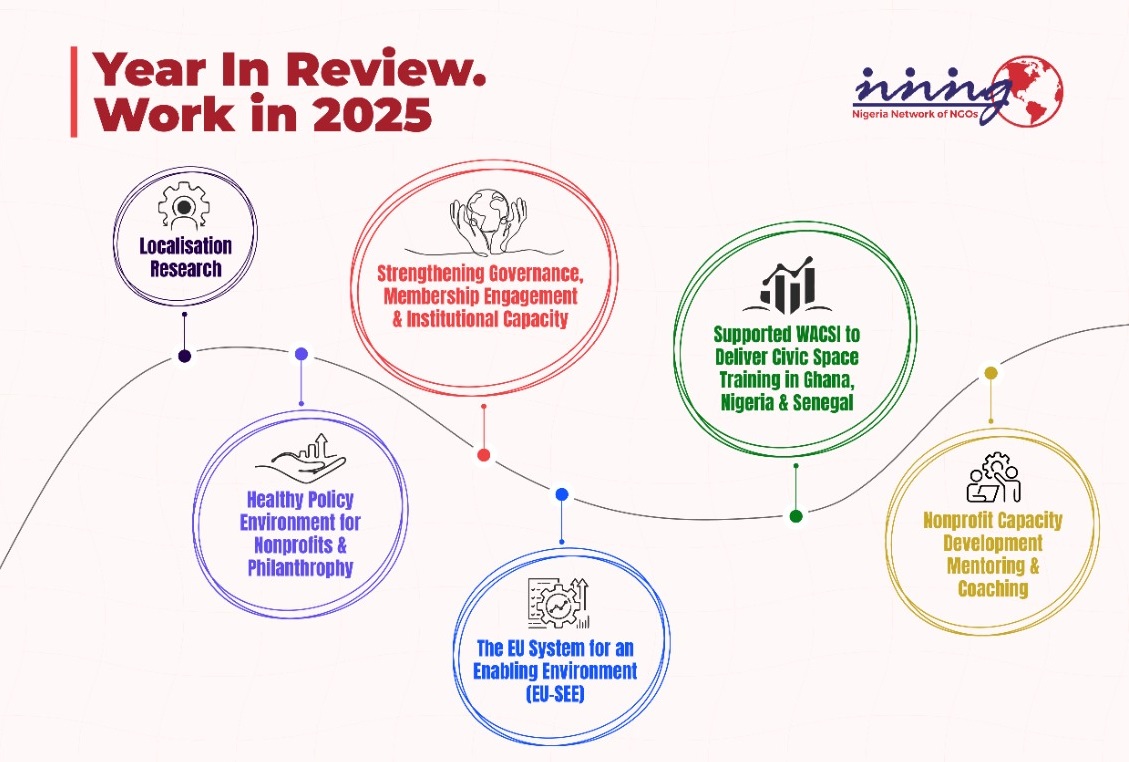
‎Throughout the year, NNNGO implemented key interventions aimed at strengthening institutional capacity and improving the operating environment for civil society. These efforts included localisation research to generate context-driven solutions, strengthening governance systems and membership engagement, and promoting a healthy policy environment for nonprofits and philanthropy.

‎The Network also played an active role in the EU System for an Enabling Environment (EU-SEE), contributing to initiatives that support civic space and civil society sustainability. Across West Africa, NNNGO supported the West Africa Civil Society Institute (WACSI) to deliver civic space training in Ghana, Nigeria, and Senegal, reinforcing regional collaboration and learning. Nonprofit capacity development initiatives through mentoring and coaching remained central to strengthening organisational effectiveness.

Our Projects Include:

‎👉Localisation Research

‎ Targeted at creating solutions to the realities, challenges, opportunities, and readiness of local civil society actors within Nigeria’s humanitarian and development ecosystem.

‎👉Strengthening Governance, Membership Engagement & Institutional Capacity

‎ Targeted at deepening member engagement, improving board governance, and expanding internal human resource and MEAL capacities.

‎👉Civic Space Protection & Accountability

‎Targeted at strengthening civic freedoms, improve nonprofit regulatory understanding, and enhance the accountability of state institutions toward Nigeria’s human rights commitments with key interventions and achievements including the development of a Policing Protest Toolkit.

‎👉Civil Society Mapping and Capacity Assessment in Nigeria

‎Targeted at mapping the CSO landscape to identify and categorise CSOs by formation geographic spread, thematic focus, and funding sources and assessing capacity needs to evaluate institutional, operational, programmatic, regulatory, technological, resource mobilisation, strategic planning, and digital protection capacities, while documenting the challenges they face in fulfilling their mission.

‎👉Nigerian Nonprofit Capacity Building Trainings

‎Targeted at enhancing NGO governance, compliance, project management, financial accountability, and organisational sustainability, ensuring that beneficiary organisations are better equipped to deliver impactful and transparent services to the communities they serve.

‎👉The EU System for an Enabling Environment (EU-SEE)

‎Targeted at strengthening national monitoring, analysis, and advocacy relating to the enabling environment for civil society.

‎👉The Civic Space Resource Hub

‎Targeted at developing the capacities of civil society organisations in Nigeria, Ghana, and Senegal.

‎Growing and Engaged Membership

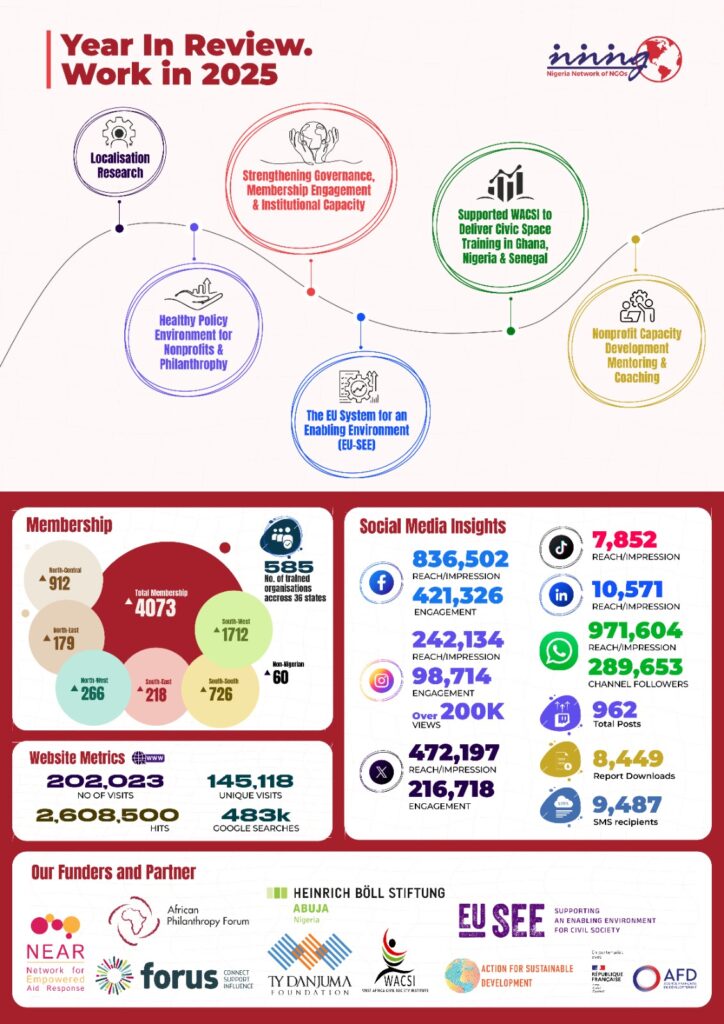
‎NNNGO’s membership base continued to expand in 2025, reaching a total of 4,073 member organisations. These members span across Nigeria’s six geopolitical zones, with strong representation in the South-West, South-South, and North-Central regions, alongside non-Nigerian members.

‎Capacity strengthening remained a priority, with 585 organisations trained across 36 states, equipping civil society actors with skills to improve governance, accountability, and programme delivery.

‎Expanding Digital Reach and Engagement

‎Digital platforms remained a powerful tool for connection and advocacy. In 2025, NNNGO’s content reached over 2.5 million people across social media platforms, generating close to one million engagements. The Network also grew its WhatsApp Channel to 289,653 followers, enabling direct and timely engagement with members and stakeholders.

‎Through SMS outreach, 9,487 recipients were reached with targeted information and updates, ensuring accessibility beyond social media platforms.

‎Website Performance and Knowledge Sharing

‎NNNGO’s website continued to serve as a central hub for information and resources. During the year, the website recorded 202,023 visits from 145,118 unique visitors, alongside 2.6 million hits and 483,000 Google searches. Knowledge sharing remained strong, with 8,449 reports downloaded, reflecting sustained demand for data, research, and sector insights.

‎Partnerships That Made the Impact Possible

‎Progress in 2025 was made possible through collaboration with valued partners and funders committed to strengthening civil society. These partnerships supported research, capacity development, civic space initiatives, and institutional strengthening across Nigeria and the region. Many thanks to NEAR, FORUS, Heinrich Böll Stiftung, WACSI, TY Danjuma Foundation Partnership,  African Philanthropy Forum, Action for Sustainable Development, Agence Francais De Developpemnt

‎

‎Looking Ahead

‎As the Network reflects on the achievements of 2025, the focus remains on deepening impact, strengthening partnerships, and advancing an enabling environment for civil society in 2026. With a growing membership and expanding reach, NNNGO remains committed to supporting nonprofits to drive sustainable development and social change.

CHEERS TO 2026!!!

The Nigeria Network of NGOs (NNNGO) is the first generic membership body for civil society organisations in Nigeria that facilitates effective advocacy on issues of poverty and other developmental issues. Established in 1992, NNNGO represents over 3495 

Do you have questions? Call or visit us.

+2349069460107

Plot 3 Sobanjo avenue, Idi-ishin Jericho Ibadan, Oyo, Nigeria.

15 Ramat Crescent, Ogudu GRA, Lagos, Nlgeria

nnngo@nnngo.org 

Newsletter

Get latest news & update

Connect With Us

© – Nigeria Network of NGO (NNNGO). All rights reserved.

Follow us on social media