
 BUSARI ABBAS
Nigeria’s Nonprofits Generate ₦16.4–17.5 Billion Annual Economic Footprint, New Evidence Report Finds
Conservative estimates from 4,234 NNNGO member organisations present in every state and the FCT show a substantial, under-recognised economic contribution and open a national conversation on the true economic weight of the sector
LAGOS, Nigeria, 22 October 2026/APO Group/ —
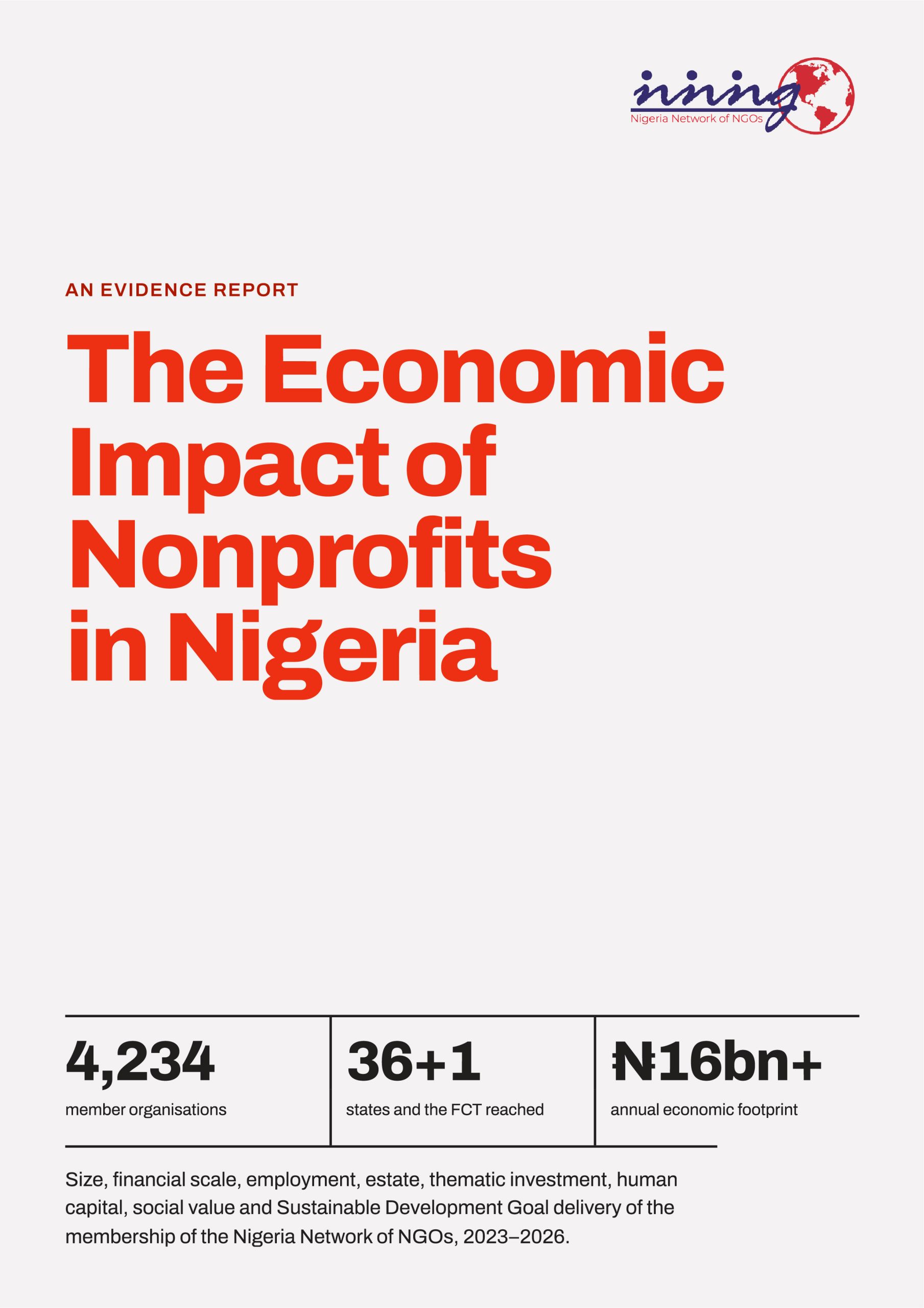
The Nigeria Network of NGOs (NNNGO) today released The Economic Impact of Nonprofits in Nigeria, an evidence report quantifying the economic contribution of its 4,234 member organisations. Present in all 36 states and the Federal Capital Territory, the membership carries a combined annual operating income of at least ₦11.7 billion (approximately ₦12.5 billion across the full membership). With supply-chain and wage effects applied using a conservative 1.4 multiplier, the total annual economic footprint is estimated at ₦16.4–17.5 billion, with a plausible range of ₦14–22.5 billion.
“Nigeria’s nonprofits are not merely providers of social services. They are serious economic actors — employers, customers of local businesses, and generators of further activity across every state,” said Oyebisi Babatunde Oluseyi, Executive Director of the Nigeria Network of NGOs. “While the limitations of the data are real and the figures may not capture the full scale of the sector, what this report offers is the start of a national conversation on the true economic impact of the nonprofit sector. It signals the economic footprint of the sector and is a true reflection of where Nigerian nonprofits are creating both social and economic value. Recognising and measuring this contribution more fully is the first step to resourcing civil society in proportion to the value it creates.”
The report draws on four evidence bases: the NNNGO membership database; an inventory of nonprofit and civil society events held between 2023 and mid-2026; a verified review of Nigerian university programme pages; and documented member impact features mapped to the Sustainable Development Goals. Key findings include:
Employment: 3,100–6,900 full-time-equivalent paid posts, plus volunteer effort equivalent to roughly a further 2,700 posts. The paid workforce is drawn in part from a pipeline spanning 13 universities and five academic disciplines, although no Nigerian university yet offers a dedicated nonprofit-management degree.
Local economic circulation: Significant recurring demand for hospitality, aviation, catering, transport, printing, professional services, commercial space (estimated ₦1.3–3.2 billion annually) and near-universal telecommunications and internet services. Events alone generate an estimated ₦0.9–2.7 billion in annual local spending.
Thematic investment: Education-focused organisations hold the largest pool of resources at ₦4.84 billion. Advocacy organisations are the most capitalised on average (₦3.67 million).
SDG delivery: Documented member impact features address 12 of the 17 Sustainable Development Goals, with local organisations frequently serving as the last-mile delivery mechanism that neither government nor the market reliably reaches.
The report is explicit about its limitations. Budgets are self-reported in bands rather than audited, the open top band is valued at a conservative floor, and the data covers one large network rather than every nonprofit in Nigeria.
Almost every limitation identified points toward understatement. Yet even with these caveats, the evidence signals a clear economic footprint and accurately reflects the areas in which the sector is generating both social and economic value. On top of the measurable market footprint sits social value — in education, health, livelihoods, inclusion, democracy and the rule of law — that cannot be fully reduced to a monetary figure and adds to, rather than competes with, the economic case.
The full report is available for download on the NNNGO website.
——————————–
About the Nigeria Network of NGOs (NNNGO)
The Nigeria Network of NGOs is the national platform for civil society organisations in Nigeria. Since 2012 it has grown from approximately 600 to more than 4,200 member CSOs, working to strengthen the enabling environment for nonprofits, advance self-regulation, and amplify the collective voice of civil society on issues of governance, development and civic space.
Media Contact
Nigeria Network of NGOs
Email: nnngo@nnngo.org
Website: www.nnngo.org