 BUSARI ABBAS
Statement by the Nigeria Network of NGOs
Abuja, 5 October 2026
On reported difficulties in accessing TikTok in parts of northern Nigeria, and their implications for freedom of expression, access to information and the work of civil society
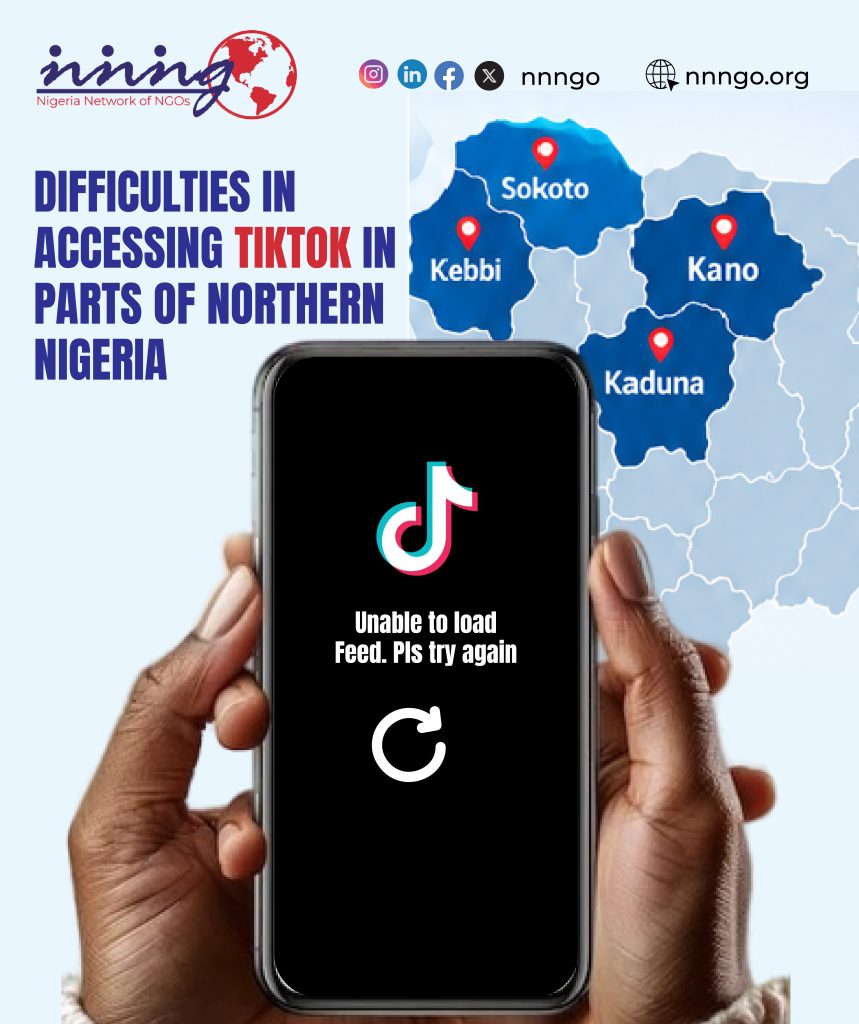
The Nigeria Network of NGOs notes with concern credible and consistent reports, dating from around mid-September 2026, of prolonged difficulty in accessing TikTok through ordinary mobile-data networks in Kaduna, Kano, Kebbi and Sokoto States. Users have described feeds that fail to load, videos that will not play and uploads that stall, while access is in many cases restored through virtual private networks. The disruption appears to cut across networks and has not been accompanied by a public explanation.
Available information does not yet establish whether these difficulties arise from a technical fault, a routing or platform-side problem, a traffic-management measure, or an intentional restriction. Neither public authorities nor civil society should reach conclusions that the technical record does not support. Unexplained interference with a widely used communications platform is nevertheless a matter of public interest. It engages the rights to freedom of expression and to seek, receive and impart information, as affirmed in Article 19 of the Universal Declaration of Human Rights and Article 19 of the International Covenant on Civil and Political Rights, and as elaborated by the Human Rights Committee in General Comment No. 34 and by the Human Rights Council in its resolutions on the promotion, protection and enjoyment of human rights on the Internet.
The effects are not confined to entertainment or private communication. In the affected states, TikTok has become a channel through which young people, community journalists, creators and small enterprises exchange information and sustain livelihoods. For nonprofit organisations, the same channel has become part of ordinary civic infrastructure. Prolonged loss of access impairs:
- Community outreach and public-information campaigns, including on health, education, humanitarian need and civic participation, where short-form video is often the most effective means of reaching audiences who do not use other platforms.
- Beneficiary feedback and early warning, as community volunteers and local partners use the platform to surface service gaps, protection concerns and local incidents.
- The visibility and resource mobilisation of smaller and community-based organisations, many of which lack paid media budgets and rely on organic reach to recruit volunteers, explain their work and account to the communities they serve.
- Journalism, documentation and public accountability, where citizen reporting and nonprofit communications depend on timely publication and circulation.
- The livelihoods of creators and micro-enterprises whose income is tied to the platform, with downstream effects on household resilience in already constrained local economies.
Taken together, these effects narrow the space in which civil society can inform, mobilise and be held to account. They fall most heavily on organisations and communities with the least capacity to route around a disruption.
NNNGO therefore calls on the Nigerian Communications Commission, relevant telecommunications providers, TikTok and other competent authorities — including, as appropriate, the National Information Technology Development Agency — to conduct and publish an independent technical investigation. That account should state the locations and networks affected, the cause and duration of the disruption, whether any official directive was issued, and the measures taken to restore service and prevent recurrence. Testing should be capable of distinguishing domain or Internet Protocol blocking, DNS interference, throttling, routing abnormalities and application-specific filtering.
Any restriction on access to a digital platform must have a clear legal basis and meet the requirements of legitimacy, necessity, proportionality and due process. Blanket or indefinite interference with a communications service is inherently difficult to justify. Users, journalists, researchers and nonprofit workers who lawfully document service disruptions — including through legitimate network measurement or the use of virtual private networks — must not face reprisals.
The Network stands ready to support evidence gathering, constructive engagement with regulators and operators, and the development of a transparent national protocol for responding to major digital-service disruptions, so that future incidents are explained promptly, remedied swiftly and never imposed outside the law.