Nonprofit Operational Manual

The Nonprofit Operational Manual is designed to assist Nigerian nonprofits to strengthen their operational and technical capacity in delivering their vision and mission. The manual aims to help nonprofits adopt best organisation practices, clarify requirements, regulations and compliance issues relating to managing a nonprofit.


It is designed as both a capacity-building tool and reference material for successfully running a nonprofit organisation and as a guide for understanding and complying with regulatory frameworks guiding the operation of nonprofits in Nigeria. Through this manual as well as training, skills-building activities and information exchanges, NNNGO hopes to enhance the performance and capacity of organisations to deliver effective services to their beneficiaries and critical stakeholders.


Click here to download 

Nonprofit Operational Manual

The Nonprofit Operational Manual is designed to assist Nigerian nonprofits to strengthen their operational and technical capacity in delivering their vision and mission. The manual aims to help nonprofits adopt best organisation practices, clarify requirements, regulations and compliance issues relating to managing a nonprofit.


It is designed as both a capacity-building tool and reference material for successfully running a nonprofit organisation and as a guide for understanding and complying with regulatory frameworks guiding the operation of nonprofits in Nigeria. Through this manual as well as training, skills-building activities and information exchanges, NNNGO hopes to enhance the performance and capacity of organisations to deliver effective services to their beneficiaries and critical stakeholders.


Click here to download

Profiling Feet of Grace Foundation

For many years now, they have been demonstrating the power of positive attitude and by all means rocketing towards their goals since its inception in November 2014.


Since 2014, The Feet of Grace Foundation has been enriching lives by raising funds to provide both upper and lower extremity prosthesis and wheelchairs to amputees; children under 18 years of age, young ladies and women alike. The Foundation has also been facilitating educational scholarship for needy amputee children while supporting catalytic activities to alleviate poverty for women amputees.


By the end of 2019, 41 amputees would have benefited from the support provided by the Foundation. This support includes 42 prosthetic limbs (3 more to be delivered by the end of the month), and two wheelchairs (including one motorized for a double amputee). Three female amputees received seed funds to reestablish their small scale businesses. Six amputees are currently benefiting from educational scholarship with support from partner-organizations.


The Feet Of Grace Foundation also supports replacement of the prosthetic limbs for the children as they grow, and repairs/maintenance of all limbs provided as they wear out from daily use.


Well-done Dr Irene Olumese and your entire team.

#MotivationalMonday #StillStanding #LeaveNoOneBehind #Agenda2030 #GlobalGoals

Profiling Feet of Grace Foundation

For many years now, they have been demonstrating the power of positive attitude and by all means rocketing towards their goals since its inception in November 2014.


Since 2014, The Feet of Grace Foundation has been enriching lives by raising funds to provide both upper and lower extremity prosthesis and wheelchairs to amputees; children under 18 years of age, young ladies and women alike. The Foundation has also been facilitating educational scholarship for needy amputee children while supporting catalytic activities to alleviate poverty for women amputees.


By the end of 2019, 41 amputees would have benefited from the support provided by the Foundation. This support includes 42 prosthetic limbs (3 more to be delivered by the end of the month), and two wheelchairs (including one motorized for a double amputee). Three female amputees received seed funds to reestablish their small scale businesses. Six amputees are currently benefiting from educational scholarship with support from partner-organizations.


The Feet Of Grace Foundation also supports replacement of the prosthetic limbs for the children as they grow, and repairs/maintenance of all limbs provided as they wear out from daily use.

Well-done Dr Irene Olumese and your entire team.

#MotivationalMonday #StillStanding #LeaveNoOneBehind #Agenda2030 #GlobalGoals

Profiling The Irede Foundation (TIF) on International Day of Persons with Disability 2019.

Amputation surgery is an orthopedic surgical procedure carried out as the last resort, when limb salvage is not feasible. It is usually associated with social, emotional and psychological disturbances to patients and their families.


The incidence of amputation in populations have a base figure of 1-2 amputees per 1000 people for all causes combined. Some causes include: trauma (34%); malignant tumours (14.5%); diabetics (12.3%); infections (5.1%); peripheral artery disease (2.1%); and burns (2.1%).


Limb loss is much more common than many people realize, and its numbers, growing by the day. It is sad to know that statistics on the numbers of amputees especially in the developing world are staggering. Globally, there are more than 1 million annual limb amputations -— one every 30 seconds.


The estimated prevalence of extremity amputation in Nigeria is 1.6 per 100,000. Reports have revealed that the number is expected to double by 2050, which will by the way be faster than population growth. Meanwhile, limb loss isn’t just costly in the financial sense; it is expensive psychologically too.  According to research, approximately 30% of people with limb loss suffer from depression, anxiety, or both. While the demands on prosthesis in third world countries are often more difficult to meet than in developed countries, one way many organisations have lent their hands(giving their widow’s mite) is in the number of artificial limbs that they have been able to deliver particularly to the less privileged in the society.


As a provider of care and prosthesis for those suffering from limb loss, The Irede Foundation understands the peculiarity of this situation and in their own little way have ensured that if not all,  at least,  some are not left behind even in their bid to making children walk,  run and play again.


In this light,  The Irede Foundation focuses on working with child amputees to give them hope and help them live a fulfilled life. The foundation is able to achieve this feat by educating the general public, while also encouraging caregivers and empowering indigent children between ages 0-18 with artificial limbs.


Activities Include:


Limb Empowerment Programme: This program sorts for child amputees whether through congenital limb loss or through trauma, providing them with prosthetic limbs from first contact to age 18. With the goal to extend their voices globally, TIF organizes an annual 2km advocacy walk tagged “Out on a Limb”. The 2019 Walk was themed “ Ensuring Inclusiveness” for children and persons living with a disability. The Walk happens simultaneously across Nigeria.


For TIF, year 2019 has been full of eventful and worthy activities and achievements. TIF 2019 Achievements include:


* Limb Empowerment Programme: The Irede Foundation has been able to empower 21 child amputees with artificial limbs in the year 2019. Cumulatively, TIF has thus far empowered 99 child amputees with 136 limbs across 17  states in the 6 geo-political zones of the country.


* Out On A Limb: Recorded successful walks across 17 states in Nigeria and 7 global locations and recorded over 1,000 people in attendance with an indirect reach of 10,000.


*Media Feature:  Few months ago,  The Irede Foundation got featured on the top two Global Media Houses: CNN and BBC


In the bid to tell the world the story of Irede,  The CNN Changemaker captured the activities of the Foundation through the eyes and voice of the Executive Director as well as the full coverage  of Prosthetic Production (http://bit.ly/IREDECNN)


The BBC African Voices was also able to focus their lenses on people who have become  beneficiaries of the Foundation. http://bit.ly/IREDEBBC


The Irede Foundation is not about ready to relent in their service to humanity, TIF wants communities to be on the lookout and refer that child amputee who is in dire need of a prosthesis to The Irede Foundation, for at the Foundation, they  believe goodness has come to every amputee child that steps into their Foundation.


Newsletter – Understanding Income and Properties for Nonprofits – Nov. 2019

November, 2019

Nonprofit organisations can continue to enjoy their nonprofit status only if they can keep to their charitable object which requires that they do not pay or transfer income, profit or properties of the organisation to any of their board members. It is expedient that the Board has the ultimate responsibility for the income and properties/assets of the nonprofit organisation including its reputation since they are also responsible for the decisions and actions of the organisation.


The Board is also has the mandate to delegate authority by ensuring suitable internal mechanism controls are put in place which allows efficient monitoring of delegated matters. The tone set by the Board through its leadership, behaviour, culture and overall performance is an important foundation for the success and sustainability of the nonprofit organisation.


It is advised that the Board of a nonprofit is informed enough about the organisation in order to defend the its integrity and strength in terms of decision-making, reporting, internal controls and asset management, for enhanced transparency and accountability processes. This helps ensure that the income and properties/assets of a nonprofit are solely used towards the promotion of the aims and objectives of the organisation as stated in its constitution and no portion of its income and property are paid or transferred directly or indirectly, by way of dividend, bonus or otherwise by way of profit to any of the members of the association.


As an internal control mechanism strategy, it is advised that the board regularly monitors the performance of its nonprofit organisation using a consistent framework, operational performance checks against delivery of the organisation’s objectives, strategic goals, budget and risks.


The Board should agree to reasonable remuneration for staff, taking into account prevailing economic indices and enforce a no-pay policy for members of the board with a clear policy on Board reimbursements for travels and meeting attendance costs.


Also, the Board should agree and oversee an effective process for appointing and reviewing independent external auditors, have a board audit committee that is headed by a chairman who has recent and relevant financial expertise and  would also meet with auditors without the staff of the organisation at least once a year.


This Board audit committee must have the capacity and expertise to consider concerns raised by staff and volunteer about improper conduct that may arise within the organisation including arrangement for proportionate and independent investigation/follow-up. Nonprofit organisations who knowingly violate this part of the Companies and Allied Matters Act shall be liable to refund such income or property as it applies to the organisation.

Profiling Sparkle Foundation on World Toilet Day

Some go to streams, some visit the bushes. Meanwhile in the process of doing this serious business, some, sadly have been bitten by reptiles.


One major outcome of the lack of sanitation facilities is open defecation, which according to some experts results in waterborne diseases outbreak such as dysentery and cholera particularly amongst children.


According to Nigeria Water, Sanitation and Hygiene Reports, the country’s sanitation sector is in near epileptic condition. It is with this aim to achieving SDG 6 for cleaner environments together with building some self-reliance, socio-economic development and improved physical wellbeing with great hope for a brighter future, Sparkle Foundation for orphans and the less privileged sees to the provision of health and educational support to the poor particularly in rural communities.


Health-concerned foundation that they are known for, Sparkle also encourages family planning for an effective birth control in several communities. Still on family planning, the Foundation partnered with NURHI (Nigerian Urban Reproductive Health Initiative) in other to create awareness on Family planning through sensitization. Sparkle Foundation was able to register 217 women for preferred methods; ranging from MICROGYNON, DEPO INJECTION, NORISTERAT INJECTION, IMPLANON and JADELLE. For the effectiveness of this sensitization, Sparkle ensured to distribute about 1,068 male and female condoms.


Sparkle has also successfully carried out various health awareness programs for children and youths; from drug abuse to mental health to basic hygiene.


At Sparkle Foundation, they believe every child through improved nutritional status and reduced physical ailments can achieve his/her potentials which can help create a viable sound future.


OTHER ACHIEVEMENTS INCLUDE:

  • Supported visual abilities of children by providing 150 children with eye drops and prescribed reading glasses to 21 children.
  • Renovation of 16 toilets for pupils and 2 Teachers’ toilets which has finally put an end to open defecation at Makoko Primary School in Lagos State.
  • Supported 2,200 families of children with food items through our Christmas Give Away, as part of our support to end hunger and malnutrition.

Committing to Realizing Positive Sustainable Change – November Newsletters 2019

Committing to Realizing Positive Sustainable Change – Istanbul Principle XIII

Over the years, Civil Society Organisations (CSOs) have embarked on programs/projects that assist communities to become empowered and ultimately attain sustainable development. In the bid to implement various sustainable development-related projects, CSOs are often encouraged to work in collaboration with beneficiaries by involving them at the various stages of the project implementation through proper consultation, information-sharing, and partnerships.


As agents of development, CSOs serve as service delivery partners and therefore act as the link between the public and private sectors as well as stand in a position to more holistically identify and address developmental gaps that have been otherwise left behind by the other two sectors. Very importantly, they serve as a political watchdog and ensure equitable governance through monitoring and reporting progress at local levels.


The eighth Istanbul principle of development effectiveness – “CSOs are effective as development actors when they collaborate to realize sustainable outcomes and impacts of their development actions, focusing on results and conditions for lasting change for people, with special emphasis on poor and marginalized populations, ensuring an enduring legacy for present and future generations” implies that; for effectiveness, self-reliance, and sustainability on project impacts, CSOs should embark on capacity building projects to develop the knowledge and skill of the community to mobilize resources.


CSOs programs should be aimed at improving the economic well-being of communities by job creation and income generation which in the long run, will contribute to sustainable community development. Proper consultation and embarking on community-driven projects motivates local level participation in developmental projects to improve their quality of life and commit to realizing sustainable change.


Project sustainability should always be factored before embarking on project activities. The beneficiaries need to feel the impact of the project even after the project/donor fund is exhausted. Project effectiveness and maintenance can be actualized through proper stakeholder mobilization, collaboration and building larger and more active local constituencies for grass root support and ensuring no one is left behind.

This newsletter is supported by Forus. However, the ideas and opinions presented in this document do not necessarily represent those of Forus , NNNGO or any other organisations mentioned.


NNNGO Launches Project to Strengthen Regulatory Frameworks for Civil Society

https://campaign-image.com/zohocampaigns/492296000002249004_zc_v8_eu_logo_with_rider.png

https://campaign-image.com/zohocampaigns/492296000002249004_zc_v38_newletters_for_project_launch.jpg

About the Project

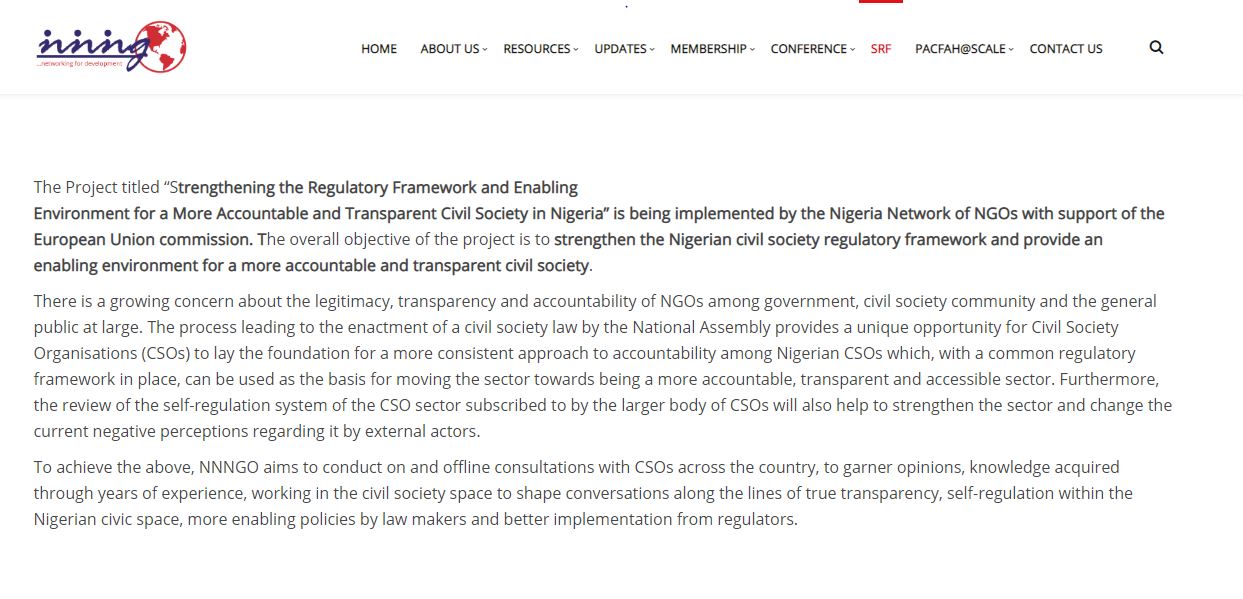
The Nigeria Network of NGOs announces the launch of a project, funded by the European Union, titled, “Strengthening Regulatory Frameworks for a More Accountable and Transparent Civil Society in Nigeria”, that focuses on current regulatory realities within the Nigerian nonprofit sector with an aim to lead conversations and actions on how these regulations can be better implemented in a way that creates an enabling operational environment for Nigerian civil society organisations (CSOs).


Project Launch

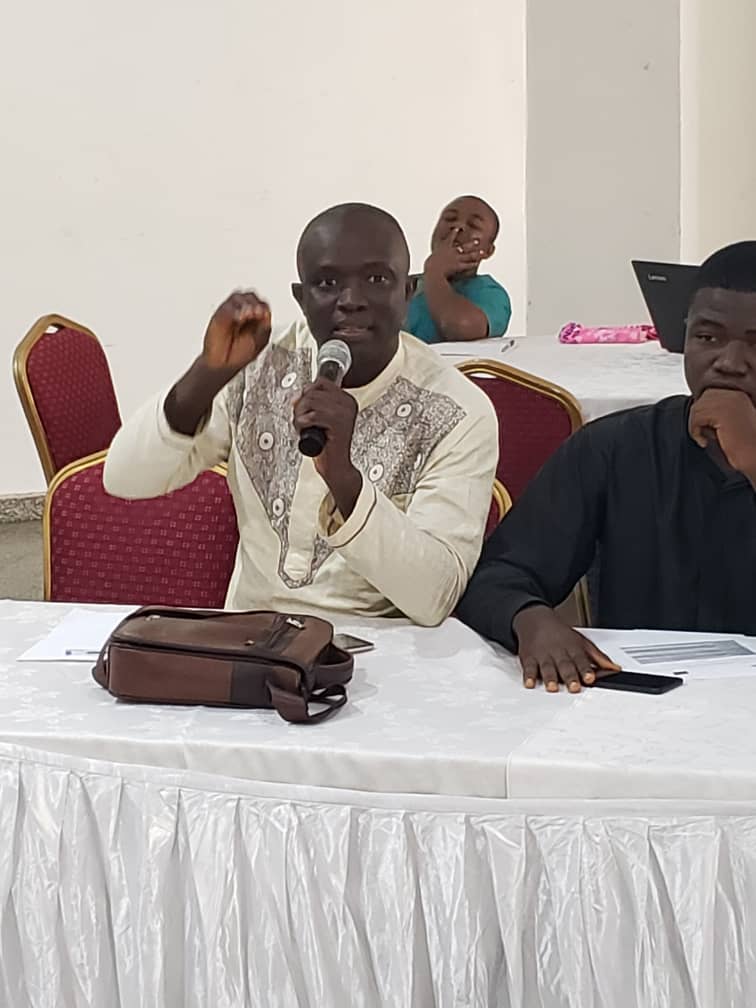
A project launch themed “Understanding Nonprofit Regulatory Frameworks; Trends and Realities” was organised in Abuja on Monday, November 4, 2019.  Participants who comprised seventy-two (72) CSOs gave insights into how best to carve out and popularize a self-regulatory mechanism that is responsive to the needs of the sector and can be effectively implemented in line with global best practices. 

https://campaign-image.com/zohocampaigns/holiday35_img2.png

The Nigerian third sector is gradually awakening to the need to work together with regulators especially with regards to compliance issues and generally improve transparency and accountability within the sector. We are confident that this project and our approach to its implementation will allow for mutual communication among civic actors, regulators, and policymakers and we can all collaborate to create an enabling regulatory environment for the sector.

https://campaign-image.com/zohocampaigns/holiday35_img3.png

Oyebisi Oluseyi, Executive Director of the Nigeria Network of NGOs.

“We are excited about this project especially as it focuses on one of our strategic pillars as organisation protection of the operational environment of Nigerian Nonprofits. We also expect that by the end of the project, one of the outcomes, among others is that it will serve as a repository of knowledge on nonprofit regulations, and provide key insights on how to incorporate global best practices into our work and the civil society sector as a whole” added Oyebisi Oluseyi. Conversations revolved around issues of registration of Nigerian Nonprofits, regulations, legitimacy, accountability, and transparency for the third sector. Participants also discussed the development of a nonprofit Code of Conduct by the sector, for the sector and approved by the Government as a guide for the operations of the Nigerian NGOs. Suggestions were made as to how nonprofits can better engage in collaborations, employ public information systems, peer review, and self-assessment mechanisms to allow growth and sustainability of organisations, especially those at the grassroots. 


A newly designed page tagged “Strengthening Regulatory Frameworks” (SRF) which offers a comprehensive understanding of the project has been created on the Network’s website www.nnngo.org where easy access is guaranteed to essential information on corporate governance within the Nigerian civil society sector, nonprofit realities as well as general information about Nigerian nonprofits. The page will be updated on a regular basis with news, pictures, and videos of project events, activities, milestones, and updates.  

https://campaign-image.com/zohocampaigns/492296000002249004_zc_v15_website_1.jpghttps://campaign-image.com/zohocampaigns/492296000002249004_zc_v15_website.jpghttps://campaign-image.com/zohocampaigns/492296000002249004_zc_v15_whatsapp_image_2019_11_05_at_12.05.12_pm.jpeg

The project is intended to include peer reviews, consultations with CSOs across the country to garner opinions on regulations that they consider ideal and enabling; engagements with regulatory authorities and the National Assembly with the aim of producing a solid self-regulatory frame for Nonprofit organisations operating in Nigeria.  


This publication is produced with funding from the European Union.

| Preference | Privacy Policy | Terms of Use

Nigeria Network of NGOs. 15, Ramat Crescent Ogudu GRA, Lagos. 

@2019 NNNGO.  www.nnngo.org.  All Rights Reserved.


How to Change Registered Particulars with the CAC – October 2019

October, 2019 


Nonprofit organisations willing to make alterations to some or all of their particulars after registering with the Corporate Affairs Commission (CAC), must notify the commission via an application process within a reasonable period of time- a duration of 28-60 days is recommended (for medium, small and large organisation) for this to take place.


In the life-cycle of nonprofits, it is not uncommon for organisations to require a change of name, object(s), constitution or some of their board of Trustees at some point and while this is within their constitutional rights as Nigerian nonprofits, there are certain processes that must be undergone by these organisations and approved by the CAC.


Before considering a change in the constitution of an organisation or parts of it, it must be noted that the change can only occur through a resolution passed by a simple majority of the members of the organisation’s board and this has to be approved by the CAC before it becomes valid.


At the expiration of the term of an organisation’s board member and to replace such an individual within the board, the CAC must be notified through an “application process” along with an advert in two daily newspapers publicly displayed for 28 days based on the provisions of the Part C of the Companies and Allied Matters Act (CAMA).


The application process to make alterations to an organisation’s particulars in these situations implies that a letter be drafted on the organisation’s letterhead stating the reasons for the change in particulars; depending on what needs to be changed (name, objects,constitution or board members of the organisation) and sent to the CAC. Very importantly, it is expected that the minutes of the meeting of the board where such decision/resolution took place is attached with this application letter.This is then followed by certain instructions from the CAC which includes an advert in two national dailies as stated earlier, among other things.


Nonprofit organisations must ensure that prescribed processes for any change they wish to effect within their organisation are followed to avoid invalid or void alterations,based on the provisions of the Part C of CAMA.

The Nigeria Network of NGOs (NNNGO) is the first generic membership body for civil society organisations in Nigeria that facilitates effective advocacy on issues of poverty and other developmental issues. Established in 1992, NNNGO represents over 3495 

Do you have questions? Call or visit us.

+2349069460107

Plot 3 Sobanjo avenue, Idi-ishin Jericho Ibadan, Oyo, Nigeria.

15 Ramat Crescent, Ogudu GRA, Lagos, Nlgeria

nnngo@nnngo.org 

Newsletter

Get latest news & update

Connect With Us

© – Nigeria Network of NGO (NNNGO). All rights reserved.

Follow us on social media